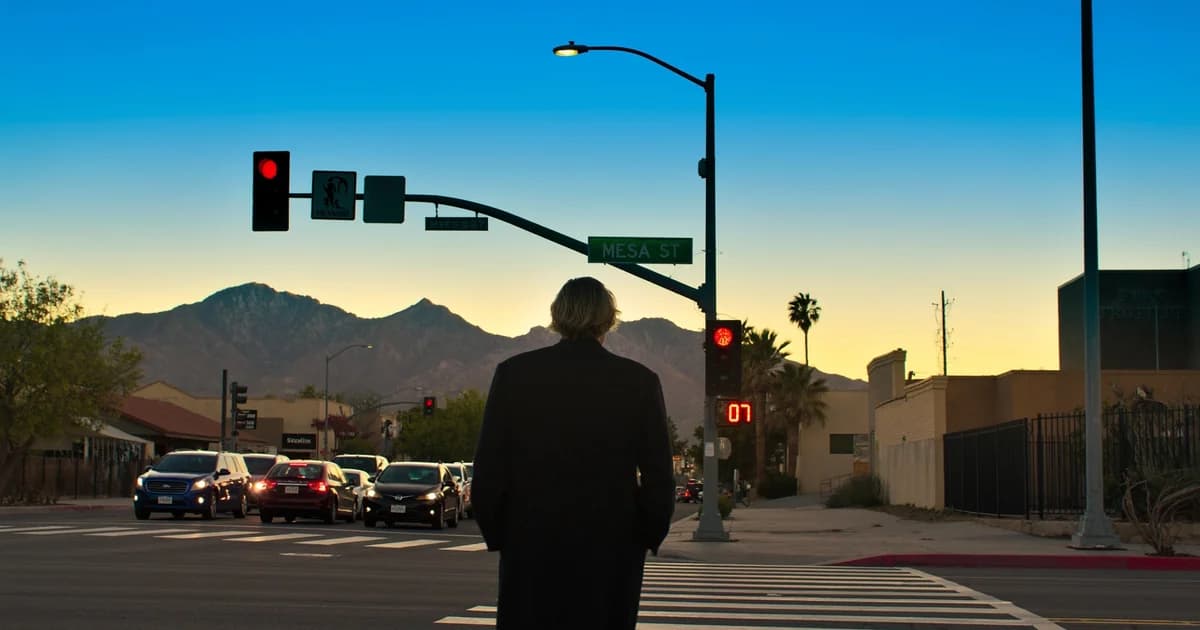
On the first Sunday in November, the clocks fall back and El Paso gets one extra hour of sleep. On Monday, the same city walks out of work at the same time it always does and finds the sun already going down. Sunset lands in the five o'clock hour instead of the six o'clock hour, and by the middle of the month the evening commute along Mesa Street, Montana Avenue, Dyer Street, Alameda Avenue, and Zaragoza Road happens entirely in the dark.
Nothing else changes. The same people wait at the same Sun Metro stops, cross at the same intersections, and walk the same routes home from work, school, and the store. The only thing different is that drivers now have to find them with headlights instead of daylight.
That is why the weeks after the time change are among the most dangerous of the year for people on foot in this city. This post explains why the pattern is so consistent, what Texas law actually requires of drivers after dark, and how to respond to the argument that pedestrians hear most often after they are hit: that they should have been wearing something brighter.
Why the First Weeks After the Change Are the Worst
The spike is not caused by darkness alone. Winter evenings are dark for months and the risk does not stay elevated the whole time. It is the abruptness that does the damage.
The change happens overnight, but habits do not. A person who has crossed Alameda Avenue at the same spot at 5:45 every evening since March has been doing it in daylight. On Monday the same crossing is a night crossing, and neither the walker nor the drivers have adjusted.
The commute now sits inside the hardest lighting window. Dusk is worse for the human eye than full darkness. Contrast collapses, headlights are not yet doing much work, and the transition between light and dark makes it harder to pick a person out of a background.
Fatigue is real. The first week after a time change disrupts sleep for a lot of people, which affects reaction time at exactly the wrong hour.
Foot traffic is at a seasonal high. Holiday shopping ramps up, school activities run later, and people are walking through parking lots at Cielo Vista and the shopping centers along Zaragoza in the dark.
Where It Happens in El Paso
Pedestrian crashes concentrate in predictable places, and the time change shifts the timing rather than the location.
Wide, high-speed arterials with long distances between signals. Alameda Avenue, Dyer Street, Montana Avenue, and Zaragoza Road all carry fast traffic through areas where people need to cross on foot. When the nearest signal is a quarter mile away, people cross where they are.
Bus stops on the far side of a wide road. A rider who can see their bus approaching will cross for it, and a stopped bus blocks the sight line of every driver behind it.
Unsignalized intersections in older neighborhoods. Many corners in the Lower Valley, in central El Paso, and in the older parts of the northeast have crosswalks in the legal sense but no paint, no signal, and no lighting.
Parking lots and driveways. A large share of pedestrian injuries happen off the street entirely, in shopping center lots where vehicles back out into pedestrian paths.
Our general overview of pedestrian accidents in El Paso goes deeper on how these claims are built.
What Texas Law Requires of Drivers After Dark
Headlights. Texas requires headlights from sunset to sunrise, and any time visibility is limited. That requirement now applies during the evening commute.
Speed appropriate to what you can actually see. Texas requires drivers to control speed as necessary to avoid a collision and to reduce speed when a special hazard exists with respect to pedestrians, traffic, weather, or road conditions. A driver whose low beams illuminate a certain distance and who is traveling fast enough that they cannot stop within that distance is outdriving their headlights. That can be negligence even at the posted speed.
Due care and heightened precaution. Texas requires drivers to exercise due care to avoid colliding with a pedestrian, to sound the horn when necessary, and to exercise proper precaution upon observing a child or an obviously confused or incapacitated person on the roadway.
Yielding in crosswalks, including unmarked ones. This is the rule drivers most often get wrong. Under Texas law a crosswalk includes the portion of a roadway at an intersection within the connections of the sidewalk lines, whether or not anything is painted on the pavement. A person crossing at a corner in a residential neighborhood with no paint is generally in a crosswalk.
Turning movements. Drivers turning at an intersection must yield to pedestrians lawfully crossing. Right turns on red are a frequent source of these collisions, because the driver is looking left for a gap in traffic while walking straight into the path of someone crossing from the right.
Attention. A driver looking at a phone at 5:40 in the evening on Montana Avenue is not going to see a person in time. Phone records are routinely part of these cases, and our post on distracted driving accidents in El Paso explains how that evidence gets developed.
The Dark Clothing Argument, and What Texas Law Actually Says
If you are hit while walking, there is a good chance an adjuster will bring up what you were wearing within the first two phone calls. It is worth understanding both why they do it and how much weight it actually carries.
Why they raise it. Texas uses modified comparative fault with a 51 percent bar. Your recovery is reduced by your percentage of responsibility, and if you are found more than 50 percent responsible you recover nothing. Every percentage point the insurer can assign to you is money they do not pay. Our full explanation of how comparative fault works in Texas covers the mechanics.
What the law actually says. There is no Texas statute requiring a pedestrian to wear light colored or reflective clothing. Wearing dark clothes is not a traffic violation and it is not evidence of carelessness on its own. A person walking home from a warehouse shift in a dark jacket in November is doing something entirely ordinary and entirely legal.
What the law does require of pedestrians. Texas does impose real duties: use the sidewalk where one is provided, walk on the left side facing traffic where there is no sidewalk, obey pedestrian control signals, and yield to vehicles when crossing outside a crosswalk. Those matter, and an honest evaluation of a case accounts for them.
How the argument is answered. Not with indignation, with evidence. The questions that actually decide it are how far the driver's headlights illuminated, how fast the driver was traveling, how long the pedestrian was visible before impact, whether the driver braked at all, what the ambient lighting was, whether the driver's attention was elsewhere, and whether the pedestrian was in a marked or unmarked crosswalk. Those questions are answered with scene measurements, a lighting analysis, vehicle data, and reconstruction. That is why an early scene investigation matters so much in a night crash.
When the Street Itself Is Part of the Problem
Sometimes the driver is not the only issue. A crossing with no lighting, a burned out streetlight that had been reported repeatedly, a signal with no pedestrian phase, a missing sidewalk that forces people into the roadway, or a crosswalk that was never restriped can all be part of why a crash happened.
Claims like that generally run against a city, a county, a transit agency, or a state agency, and those claims live under the Texas Tort Claims Act. Two things about that statute matter immediately:
- Damages are capped, at levels set by the statute rather than by the severity of the injury.
- Formal written notice is required far sooner than the ordinary deadline, often within six months, and some cities impose even shorter notice periods under their own charters.
Missing the notice deadline generally ends the claim regardless of its merit. If a lighting or road design problem may be part of your case, that is a reason to call a lawyer in days rather than months.
What to Do If You Are Hit While Walking
- Call 911 and accept transport. Pedestrian injuries are routinely worse than they feel at the scene. Adrenaline is powerful and internal injuries are quiet.
- Do not tell anyone you are fine. It is the most natural thing in the world to say, and it is quoted back to you for the next year.
- Photograph the lighting. If you cannot, ask someone to return to the location at the same time the next evening and photograph the streetlights, the crosswalk markings or lack of them, and the sight lines. Lighting conditions are provable, but only if someone documents them.
- Get witness names immediately. Drivers who stop, people at the bus stop, and employees of nearby businesses. They leave within minutes.
- Ask about cameras that same week. Businesses, apartment complexes, and traffic signals may all have footage, and most of it is overwritten quickly.
- Keep your clothing and shoes. Do not wash them. They can carry paint transfer, impact evidence, and information about reflectivity.
- Follow through on every appointment. Gaps in treatment are the most common way a serious pedestrian claim gets devalued.
- Do not give a recorded statement. The driver's insurer will call quickly and the questions will be about what you were wearing and where you were crossing.
- Call an attorney early. Night crash cases depend on evidence that has a short shelf life.
Serious pedestrian collisions frequently produce catastrophic injuries, and those cases require different preparation than a minor crash. Our serious injury practice handles them.
Talk to Lovett & Murray After a Pedestrian Crash
Being hit while walking is not a fair fight in the insurance system. There is no vehicle around you, no airbag, and no second policy, and the argument against you starts before you leave the hospital. Our job is to even that out.
Lovett & Murray has represented injured pedestrians and their families in El Paso for more than 30 years. We investigate the scene while the conditions can still be documented, we bring in reconstruction and lighting experts when a case needs them, and we answer the dark clothing argument with facts.
Consultations are free. We work on a contingency fee, which means you pay nothing unless we win your case. Our team is bilingual in English and Spanish.
Contact us today or call 915-757-9999. If the crash happened at a corner with poor lighting, please call quickly, because a claim involving a government entity may have a notice deadline measured in months.
See our articles more often on Google.