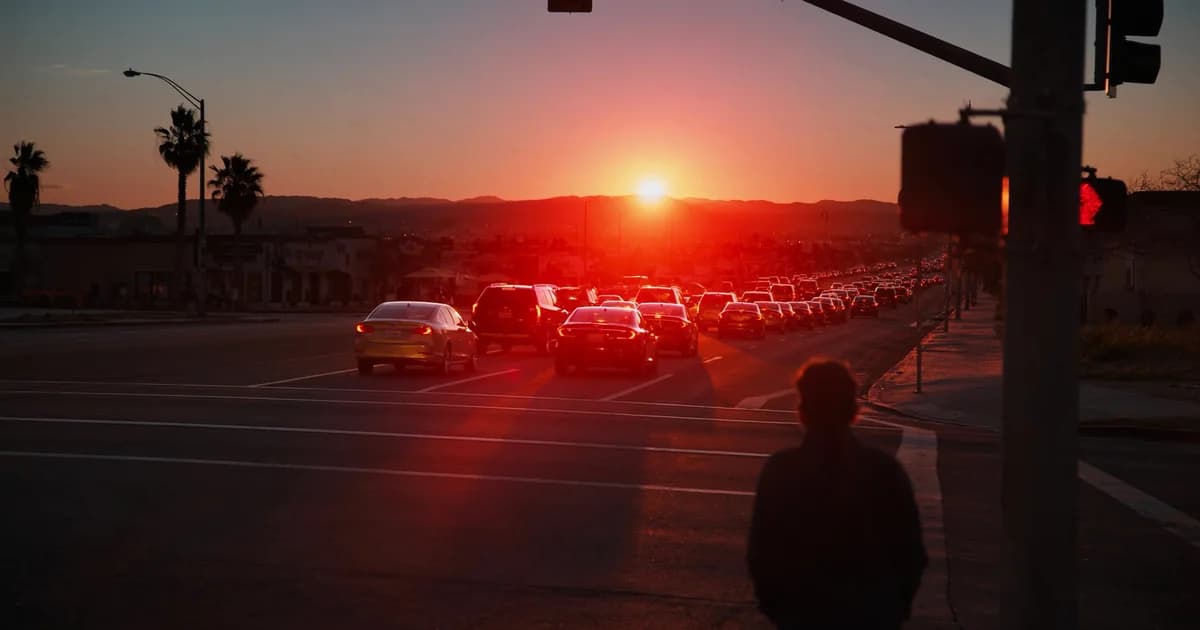
The first Monday after daylight saving time ends is one of the strangest driving days of the year in El Paso. Nothing about the roads has changed. Interstate 10 still runs the same line through the valley. Montana Avenue still carries the same eastside traffic past the airport. Mesa Street still fills the same way at five in the afternoon. What changed is the clock. The drive you made in full daylight all through October now happens with the sun sitting flat on the horizon, an hour earlier than your body expects.
In a city laid out the way El Paso is, that shift matters more than it does almost anywhere else in Texas. Our major arterials run east and west because the Franklin Mountains and the Rio Grande valley force them to. A driver heading home westbound on Interstate 10, Montana Avenue, or Alameda Avenue in early November is aiming the windshield straight into a low sun with almost nothing between the car and the horizon. For two or three weeks, the worst of that glare lands squarely in the middle of the evening rush.
This article explains why the sunset commute produces a predictable crash pattern in El Paso every November, which corridors are worst, what Texas law actually requires of a driver who cannot see, and why the sentence "the sun was in my eyes" hurts the driver who says it instead of protecting him.
Why the End of Daylight Saving Time Creates a Sunset Rush Hour
The change itself is small. Clocks move back one hour on the first Sunday in November, and El Paso sunset drops from a little after six in the evening to a little after five. The problem is what that one hour collides with.
The peak commute does not move. People still leave work between four thirty and six. Before the time change, that entire window happened in daylight. After it, the last half of it happens at sunset and then in the dark. The same volume of traffic is now moving through the single worst lighting condition of the day.
Your body has not adjusted yet. The fall time change disrupts sleep rhythm for several days even though the clock technically gives an extra hour. Drivers that first week are more likely to be drowsy in the late afternoon, and drowsiness and glare are a bad combination.
Children and pedestrians are suddenly out in the dark. After school programs, sports practice, and evening shifts at Cielo Vista release people onto sidewalks at the exact hour that just became dark. A child who walked home in daylight on Friday is crossing at dusk on Monday.
Drivers overcorrect for the glare. People pull the visor down, tilt their head, squint, or lean forward. Every one of those responses shrinks the field of view. A visor at the wrong angle can hide a pedestrian in a crosswalk entirely.
Where Sun Glare Is Worst in El Paso
Not every road is equally dangerous. The glare corridors in El Paso are consistent year after year.
- Westbound Interstate 10 from Zaragoza Road into downtown. Long straight sightlines, heavy stop and go traffic, and merging trucks coming off the international bridges. This is the highest-risk glare stretch in the county, and it is the same corridor we wrote about in our piece on sun glare crashes on Interstate 10.
- Montana Avenue heading west from the airport. Wide, fast, and lined with driveways and business entrances where drivers pull out into traffic they cannot see clearly.
- Alameda Avenue through Ysleta and Socorro. Older roadway, frequent pedestrian crossings, and a mix of local traffic and commercial vehicles.
- Transmountain Road westbound. The descent toward the west side puts drivers pointed directly at the horizon with a grade that already increases stopping distance.
- Mesa Street and Dyer Street. Both carry heavy evening pedestrian traffic near shopping, transit stops, and the edges of Fort Bliss.
Two local conditions make El Paso glare worse than the same sun angle would be elsewhere. Fine airborne dust scatters light and turns a manageable low sun into a white wall across the windshield. So does windshield pitting, the microscopic damage left by years of gravel on Interstate 10 and Loop 375. Glass that looks fine at noon can be nearly opaque at sunset.
Why "The Sun Was in My Eyes" Is Not a Defense in Texas
Drivers say it at the scene constantly, usually because they think it explains the crash. Legally, it does the opposite.
Texas negligence law asks a simple question: did the driver use the care that a reasonably careful person would have used under the same circumstances? Part of that care is the duty to keep a proper lookout, and part of it is the duty to control the vehicle. Texas Transportation Code Section 545.351 requires a driver to travel at a speed that is reasonable and prudent under the conditions then existing, and to control speed as necessary to avoid colliding with another person or vehicle. Glare is one of those conditions. It is not an exception to them.
So when a driver says the sun blinded him, he has just told everyone that he continued driving at speed while unable to see the road ahead. A reasonably careful driver in that situation slows down, lengthens the following distance, or pulls over until the angle changes.
What about the sudden emergency defense? Texas does recognize that a driver facing a genuine, unexpected emergency is judged on how a reasonable person would react in that moment. It does not apply to conditions the driver should have anticipated. The sun setting in the west in November is the definition of a foreseeable condition. It happens every single evening, at a predictable time, on a predictable heading.
What the insurance adjuster will try instead. Expect to hear that the crash was unavoidable, or that you were driving into the same sun and share the blame. That second argument is the one to watch, because Texas uses modified comparative fault, and fault percentages are often the difference between a fair settlement and a low one. We cover that in our guide to comparative fault in Texas.
What Careful Drivers Are Expected to Do in November
If you drive west in the late afternoon, a few habits significantly reduce your risk and also help demonstrate that you were driving reasonably if a crash does happen.
Clean the inside of your windshield. Interior film is the single biggest amplifier of glare, and almost nobody cleans it.
Turn your headlights on before you think you need them. They do very little for your own vision at sunset, but they make your vehicle visible to the driver crossing in front of you who is squinting into the same sun.
Double your following distance. Rear-end collisions are the signature glare crash. When you cannot see brake lights until you are close, the only remaining safety margin is space.
Keep polarized sunglasses in the car through November. They cut horizontal glare in a way that a visor cannot.
Commercial carriers are held to a higher standard. Trucking companies on Interstate 10 and Loop 375 are expected to plan routes, schedules, and driver training around known conditions, and a carrier that pushes a westbound run at sunset can share responsibility for the crash.
Pedestrians and Cyclists in the New Five O'Clock Dark
The most serious injuries in the weeks after the time change usually are not car to car. They involve someone on foot.
Texas law requires drivers to yield to pedestrians in marked crosswalks and, at intersections, in unmarked crosswalks as well. That duty does not weaken because the light is bad. If anything, poor visibility increases what a careful driver must do, because the risk of not seeing someone has gone up.
The practical danger is that pedestrians do not change their behavior when the clock does. People cross Alameda Avenue, Dyer Street, and Paisano Drive at the same times, in the same clothes they wore last week when it was still light. Drivers, meanwhile, face glare in one direction and full darkness twenty minutes later. If you were struck while walking, the issues in your case are different from a vehicle collision, and we walk through them in our article on pedestrian accidents in El Paso.
What to Do After a Sun Glare Crash in El Paso
-
Call 911 and ask for a police report. The officer's narrative often records the other driver's own words about the sun, and that statement is valuable later.
-
Photograph the sun, not just the damage. Take pictures facing your direction of travel so the sun's position appears in the frame. The time stamp on those photos fixes exactly where the sun was at the moment of the crash. Few people think to do it, and it is powerful evidence.
-
Write down your direction of travel and the exact block. Glare cases turn on geometry. Westbound on Montana at Airway is a different fact pattern from northbound on Airway.
-
Get medical attention the same day. Rear-end and side-impact injuries to the neck and back frequently feel manageable for twenty four to forty eight hours and then are not. A gap in treatment is the first thing an adjuster will use against you.
-
Identify video sources immediately. Gas stations and shopping centers along these corridors record continuously and overwrite within days. A letter sent quickly can preserve footage that would otherwise be gone.
-
Decline the recorded statement. The adjuster will call within a day or two and will ask, in a friendly tone, whether the sun was bothering you as well. Politely decline until you have spoken with a lawyer.
-
Talk to an attorney before you accept anything. Glare crashes are among the most disputed car accident claims in El Paso, because both drivers faced the same condition.
Talk to an El Paso Attorney About Your Sunset Crash
For more than 30 years, Lovett & Murray has represented El Paso drivers, passengers, and pedestrians hurt in these exact conditions on these exact roads. We know how quickly the security video along Montana Avenue disappears, and we know the arguments insurance companies use to turn a rear-end collision into a shared-fault fight.
Our consultations are free. We work on contingency, which means you owe nothing unless we win your case. Our team is bilingual in English and Spanish, and our office is here in El Paso, not in a call center in another state.
If you were injured during the sunset commute, contact us today or call 915-757-9999. Evidence in a glare case fades fast. The sooner we start, the more of it we can protect.
See our articles more often on Google.