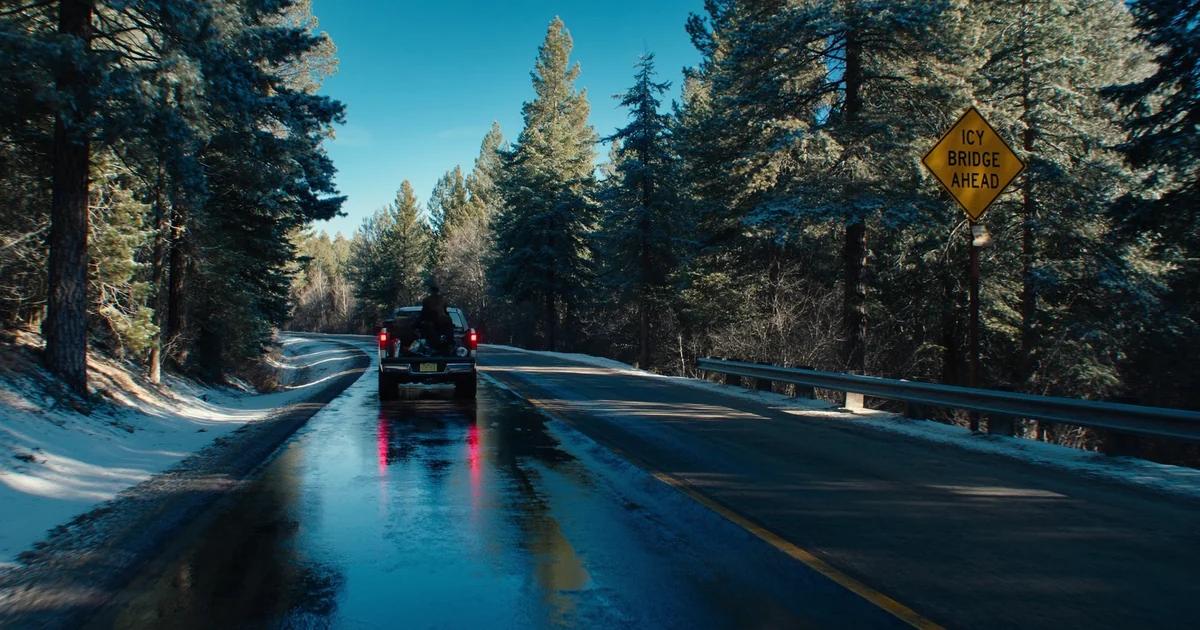
The drive from El Paso to Cloudcroft takes about two hours and climbs more than five thousand feet. You go north on U.S. Highway 54 past Fort Bliss and the Organ Mountains, through Alamogordo, and then U.S. Highway 82 begins to climb: switchbacks, a tunnel cut through the rock, and a temperature that drops the whole way up. It can be 74 degrees in the Lower Valley when you leave and below freezing when you park.
That gap is the whole problem. In mid to late October, El Paso is still in short sleeves. The mountain roads to Cloudcroft, Ruidoso, and Mescalero have already had their first freezing nights, and the first ice of the season shows up before anyone has changed how they drive. It usually shows up in shade, on a bridge, or in the outside lane of a curve, and it is invisible.
If you were hurt in a crash on one of those highways, you now have a case that lives in another state. This post explains what makes early season ice so dangerous on these particular roads, and what changes legally when a Texas family's crash happens in New Mexico.
Why Early Season Ice Catches El Paso Drivers
Late season ice, in January and February, catches almost nobody by surprise. October ice does, and for understandable reasons.
The forecast you checked was for El Paso. A 70 degree afternoon in the Lower Valley tells you nothing about conditions at 8,600 feet in Cloudcroft or 6,900 feet in Ruidoso.
Nothing about the road looks wrong. Black ice is not white. It is a thin, transparent glaze that takes on the color of the pavement underneath. Drivers routinely describe it as looking like a wet spot, right up until the steering goes light.
The first freeze arrives before the maintenance routine does. Early in the season, treatment crews are responding to the first events of the year rather than running an established winter pattern.
Most El Paso drivers have almost no ice experience. That is not a criticism. We get a handful of freezing days a year down here. Recovering from a slide is a learned skill, and instinct works against you: braking hard and steering sharply are both exactly wrong.
Tires are set up for the desert. Tread that is perfectly adequate for Interstate 10 in the summer heat can be marginal on a cold, wet mountain grade.
Where Ice Forms First on These Specific Roads
Ice is not evenly distributed, and on the roads out of El Paso it forms in predictable places.
Bridges and overpasses. Cold air moves over and under a bridge deck, so a bridge freezes before the road on either side of it. This is the single most common surprise on U.S. Highway 82 and on New Mexico State Road 244.
Shaded curves on north-facing slopes. On the climb to Cloudcroft, some curves never see sun in October. Those sections can hold ice at midday while the sunny stretch two hundred yards behind is completely dry.
Runoff crossings and seeps. Water that seeps across the pavement from a cut bank refreezes overnight and again at dusk. These recur in the same spots year after year.
The high grades on the way to Ruidoso. U.S. Highway 70 climbs through the Mescalero Apache Reservation before dropping into Ruidoso, and the elevation swings on that stretch mean conditions change several times over a short distance.
Anywhere the sun sets behind a ridge. In the mountains the sun goes down early behind the terrain, and a road surface that was above freezing at 4:30 can be below it by 5:15.
If you are driving up this fall, the practical advice is simple. Slow down before the curve rather than in it. Increase your following distance dramatically. If you start to slide, ease off the throttle, keep your eyes and hands pointed where you want the car to go, and do not stomp the brake.
Which State's Law Applies When You Crash in New Mexico
Here is the part that surprises most El Paso families. Your crash is legally a New Mexico event, even though everyone involved may live in Texas, the insurance was bought in Texas, and the medical treatment happens in Texas.
As a general rule, courts apply the substantive law of the state where the injury occurred. Texas courts use a most significant relationship analysis, weighing where the injury happened, where the conduct happened, where the parties live and do business, and where the relationship between the parties is centered. In an ordinary crash between strangers, the place of the crash usually carries the day.
That determination is not academic. It changes the rules of your case in ways that matter enormously.
Three Differences That Actually Change Your Case
1. New Mexico uses pure comparative negligence. Texas does not.
This is the largest difference, and it cuts both ways.
Texas uses modified comparative fault with a 51 percent bar. If you are found more than 50 percent responsible for your own injury, you recover nothing at all. Below that line, your recovery is reduced by your percentage. Our detailed explanation of how comparative fault works in Texas covers how insurers use that bar as leverage.
New Mexico uses pure comparative negligence. There is no bar. An injured person found 70 percent responsible can still recover 30 percent of their damages.
In an ice crash, where the defense theme is almost always that the injured driver was going too fast for conditions, that difference can decide whether a claim is viable. A case that would be dead in Texas may be worth pursuing in New Mexico.
2. The filing deadline is different.
Texas generally gives you two years from the date of injury to file a personal injury lawsuit. New Mexico generally gives three. Our overview of the Texas statute of limitations explains the Texas side.
Do not treat the longer New Mexico deadline as breathing room. Which state's limitations period applies is itself a legal question, and Texas courts can apply their own procedural rules in some circumstances. The safe assumption is the shorter deadline until a lawyer confirms otherwise.
3. Claims involving a government entity have their own short clock.
If a road condition, a maintenance failure, or a government vehicle is part of your claim, you are in a different system entirely. New Mexico claims against public entities fall under the New Mexico Tort Claims Act, which requires written notice within a short window, commonly 90 days from the occurrence, and which limits what can be recovered. Texas has its own version with its own deadlines under the Texas Tort Claims Act.
Miss the notice window and the claim is generally gone, no matter how strong it was. This is the single most common way a valid road condition case dies.
There is one more wrinkle specific to the Ruidoso corridor. U.S. Highway 70 crosses tribal land, and a crash on a reservation can raise questions about which court has jurisdiction and which sovereign's rules apply. Those questions are answerable, but they need to be identified early rather than discovered late.
Does Your Texas Insurance Follow You Across the Line?
Yes. A standard Texas auto policy provides coverage while you are driving in New Mexico, and most policies include an out-of-state provision that adjusts your coverage upward if the state you are in requires more than your policy provides.
What changes is the other side of the equation.
The other driver's limits may be different. New Mexico sets its own minimum liability requirements. If the at-fault driver carries minimum coverage and you have a serious injury, the available liability limits may be nowhere near your actual losses.
Your uninsured and underinsured motorist coverage becomes central. This is the coverage that steps in when the at-fault driver has too little insurance or none. Before a mountain trip is a good time to look at your declarations page and see what you actually carry.
Medical care may span two states. You may be stabilized in Alamogordo or Ruidoso and then treated for months in El Paso. Keeping those records connected is important, both for your health and for proving the injury.
What to Do After a Crash on a New Mexico Mountain Highway
- Get out of the roadway if you safely can. On an icy grade, the vehicles behind you have the same traction problem you just had. Standing next to your car on the pavement is dangerous.
- Call 911 and say where you are. Mile markers on U.S. Highway 82 and U.S. Highway 70 are how responders find you. Cell coverage is inconsistent, so if you get through, give the location first.
- Photograph the surface, not just the damage. Take photos of the ice, the shade line, the bridge deck, any sand or treatment on the road, and the temperature reading in your car. This evidence disappears within hours as the sun comes up.
- Note who responded. It may be the New Mexico State Police, a county sheriff, or a tribal agency, and the report request process differs for each.
- Get medical attention before you drive home. People routinely decline treatment in the mountains and drive two hours back to El Paso with a concussion or a spinal injury. Get evaluated locally, then follow up with your own doctor in El Paso.
- Do not give a recorded statement. In an ice crash the adjuster's questions are designed to get you to say you were driving too fast for conditions. Decline politely and talk to a lawyer first.
- Call an attorney who handles cases on both sides of the state line.
Serious mountain crashes frequently involve severe injuries, and those cases require a different level of preparation than a fender bender. Our serious injury practice is built for exactly that.
Talk to Lovett & Murray About a Crash Across the State Line
The drives to Las Cruces, Cloudcroft, Alamogordo, and Ruidoso are part of ordinary life in El Paso. So are the crashes that happen on them. A case that crosses the state line is not a complication we hand off. It is a normal part of what we do.
Lovett & Murray has represented El Paso and West Texas families for more than 30 years. We will sort out which state's law applies, which deadlines control, which policies are available, and what your claim is worth, before an insurer tries to answer those questions for you.
Consultations are free. We work on a contingency fee, so you pay nothing unless we win. Our team is bilingual in English and Spanish.
Contact us today or call 915-757-9999. If your crash involved a government entity or a road condition, please call quickly, because the notice deadline may be measured in weeks.
See our articles more often on Google.