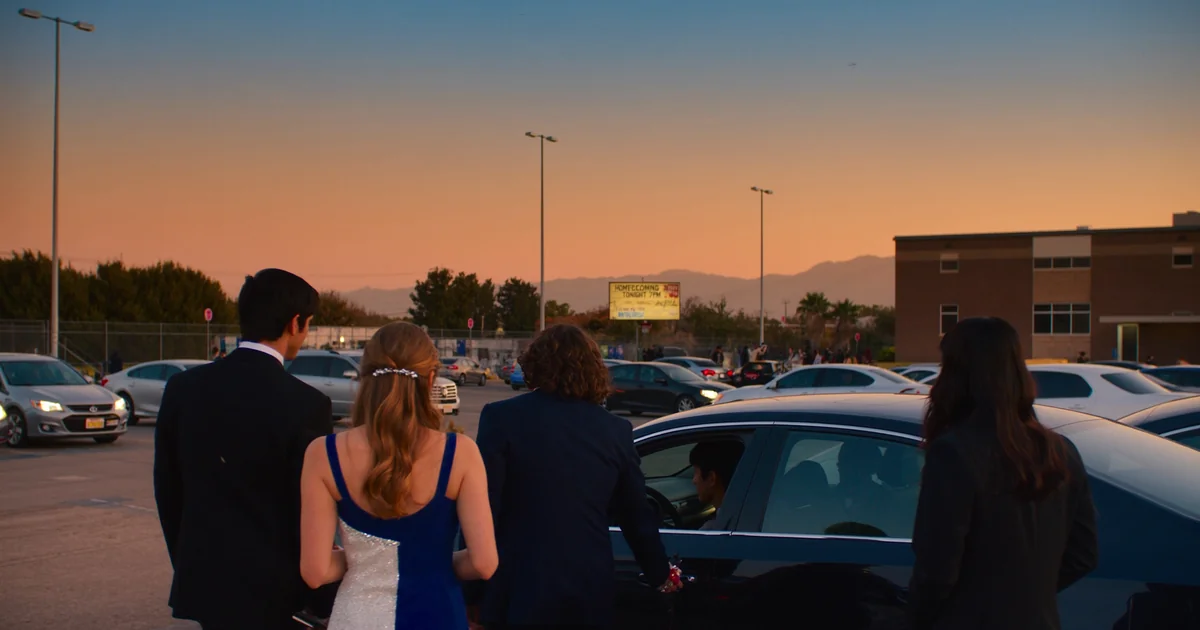
Homecoming week in El Paso runs on a schedule everyone here knows by heart. Mums the size of dinner plates. A Friday night game at a packed high school stadium on the east side or up in the northeast. Then Saturday, a rented tux, an early dinner near Cielo Vista or on the west side, a dance that lets out late, and a caravan of cars full of sixteen and seventeen year olds heading down Mesa Street or across Loop 375 with the windows down.
It is one of the best weekends of a teenager's year. It is also one of the highest risk driving nights on the fall calendar, and for reasons that have very little to do with recklessness. Teen crash risk rises with darkness, with unfamiliar routes, with a full car, and with a schedule that pushes drivers past the hours they normally drive. Homecoming weekend supplies all four at once.
This post covers what Texas law actually requires of a young driver, when a parent can end up financially responsible for a crash, and what to do in the first hours if your family is the one that gets the phone call.
Why Homecoming Weekend Is Different From an Ordinary Saturday
The individual ingredients are all ordinary. Together they change the odds.
Night driving on unfamiliar routes. Most teen driving happens on the same three or four routes: home, school, work, a friend's house. Homecoming night sends them to a venue they have never driven to, often on the other side of town, in the dark, and then back home on a route they are figuring out in real time.
Full cars. Homecoming is a group event. Four or five teens in one car is the norm, not the exception, and it is also the single strongest predictor of a teen crash short of alcohol.
Time pressure. Dinner reservations, photo timing, a curfew, a dance that ends at a set hour. Every one of those creates a reason to drive faster than the driver otherwise would.
Late hours. A dance that ends at 11:00 p.m. followed by a stop somewhere puts inexperienced drivers on the road at exactly the hours when impaired drivers from every other part of the city are also out.
Formal wear and a phone. Dresses, heels, and a phone that will not stop lighting up with group chat messages. Every one of those is a reason for a driver's eyes to leave the road.
None of that makes a teenager a bad driver. It makes an inexperienced driver face a set of conditions that would challenge an experienced one.
What Texas Graduated Driver Licensing Actually Restricts
Texas uses a graduated driver licensing system, which phases in full driving privileges instead of granting them all at once. Parents often know it exists without knowing exactly what it says, and teens frequently believe restrictions ended earlier than they did.
The learner phase. A teen who has completed the required classroom instruction can get a learner license at 15. During this phase a licensed adult 21 or older must be in the front passenger seat at all times.
The provisional phase. A Texas driver who is at least 16 and has met the learner and behind-the-wheel requirements can get a provisional license. For the first twelve months of that license, or until the driver turns 18, three restrictions apply:
- No more than one passenger under 21 who is not an immediate family member.
- No driving between midnight and 5:00 a.m., except for work, a school-sanctioned activity, or a medical emergency.
- No wireless communication device, at all, including hands free.
The under 18 phone ban is total. Texas prohibits drivers under 18 from using a wireless communication device while driving, period. There is no legal way for a 17 year old to be on a phone behind the wheel in this state.
Two things follow from that list. First, a car full of friends leaving a dance at 12:30 a.m. is very likely violating at least two restrictions at the same time. Second, those violations matter after a crash. A traffic citation is not the same thing as civil liability, but proof that a driver was violating a licensing restriction at the moment of impact is powerful evidence that the driver was not exercising ordinary care.
The Passenger Rule Exists Because Passengers Are the Risk
The passenger restriction is the part of the Texas system that teens resent most and that safety researchers defend most strongly. The reason is simple. For an adult driver, passengers are roughly neutral. For a teen driver, each additional teen passenger measurably increases crash risk, and the effect compounds.
Passengers change teen driving in three ways:
Attention. Conversation, music, someone leaning between the seats, someone filming a video. The driver's cognitive load goes up while their eyes and hands are already busy.
Social pressure. A teen driving alone drives for themselves. A teen driving four friends drives partly for an audience, and the audience rewards speed and daring.
Delay in reacting. More noise and more movement inside the car means a longer gap between something appearing on the road and the driver noticing it.
If your teen is driving on homecoming night, the highest-value safety decision available to you is not a lecture about speed. It is limiting who is in the car. We wrote about this same pattern in the context of summer driving in our post on teen driver accidents during the 100 deadliest days, and it holds just as true in October.
When a Parent Can Be Held Responsible in Texas
Families are often surprised to learn that liability for a teen crash does not always stop with the teen. Texas recognizes several routes to parental responsibility, and which one applies depends on the facts.
Signing the license application. In Texas, the adult who signs a minor's application for a driver license generally accepts joint liability for damages caused by that minor's negligence while driving. Most parents sign that form without registering what they are agreeing to. It is one of the most direct paths to parental exposure in a teen crash claim.
Negligent entrustment. If a parent hands the keys to a driver they knew or should have known was likely to drive unsafely, the parent can be independently liable. That includes letting a teen drive who has no license, who has been drinking, who has a documented pattern of reckless driving, or who is knowingly violating a licensing restriction.
Negligent supervision. In some circumstances a parent who fails to exercise reasonable control over a minor can be liable for harm that results.
The family purpose and vehicle ownership questions. The registered owner of the vehicle and the named insured on the policy both matter to how a claim gets paid, separate from who was driving.
Property damage caused by willful conduct. The Texas Family Code makes parents responsible for certain property damage caused by a child's willful and malicious conduct, subject to a statutory limit. This is narrower than most people assume and does not cover ordinary negligent driving.
If your family is on either side of a teen crash, these theories are worth evaluating early. They change who the claim is against and which insurance policies are in play. Our car accident practice handles this analysis regularly for El Paso families.
Alcohol, After-Parties, and Texas Social Host Liability
Not every homecoming night involves alcohol. Enough of them do that it belongs in this conversation.
Texas treats commercial alcohol providers and private hosts very differently.
Bars and restaurants can be liable under the Texas Dram Shop Act when they serve someone who is obviously intoxicated to the point of being a clear danger, and that person then causes harm.
Private hosts face a much narrower rule. Texas social host liability generally applies when an adult knowingly serves or provides alcohol to a minor under 18 who is not their own child, and that minor then causes injury. An adult who hosts an after-party where teenagers drink is squarely in the zone this rule was written for.
Zero tolerance also applies to the teen. Texas prohibits a minor from operating a vehicle with any detectable amount of alcohol in their system, not a reduced limit, any amount. For more on how Texas treats impaired driving generally, see our overview of Texas driving while intoxicated laws and penalties.
What to Do If Your Teen Is in a Crash on Homecoming Night
The call usually comes from a friend's phone, and it usually comes with incomplete information. Here is the order that matters.
- Ask for an ambulance. Teens routinely tell everyone at the scene that they are fine. Adrenaline is doing that talking. Concussions, internal injuries, and soft tissue injuries commonly present hours later.
- Get every passenger's name and phone number. Every car in a homecoming crash tends to be full. Each of those teenagers is both a potential injury claim and a witness, and they scatter fast.
- Photograph everything. The vehicles, the road, the lighting, the signage, and the position of the cars before anyone moves them if that is safe to do.
- Do not let your teen give a recorded statement. An adjuster may call the next morning. A seventeen year old who feels responsible will apologize for things that were not their fault, and that recording follows the claim.
- Get the crash report. It typically takes several days to become available and it is the backbone of the claim.
- Follow up medically in the next few days, even if the emergency room cleared your teen. A continuous treatment record is what connects an injury to the crash.
- Talk to an attorney before you sign anything. Teen crash claims often involve several policies, several injured passengers competing for the same limits, and questions about parental liability. Those are not questions to answer on your own at 2:00 a.m.
Talk to Lovett & Murray About a Teen Driver Crash in El Paso
If your family is dealing with a homecoming weekend crash, whether your teenager was driving, riding, or hit by someone else's, our team can help you understand who is responsible, which policies apply, and what your claim is worth before an insurer makes an offer.
Lovett & Murray has represented El Paso families for more than 30 years. Consultations are free, we work on a contingency fee so you pay nothing unless we win, and our team is bilingual in English and Spanish so every member of your family can be part of the conversation.
Contact us today or call 915-757-9999. We will handle the adjusters and the paperwork while you take care of your kid.
See our articles more often on Google.