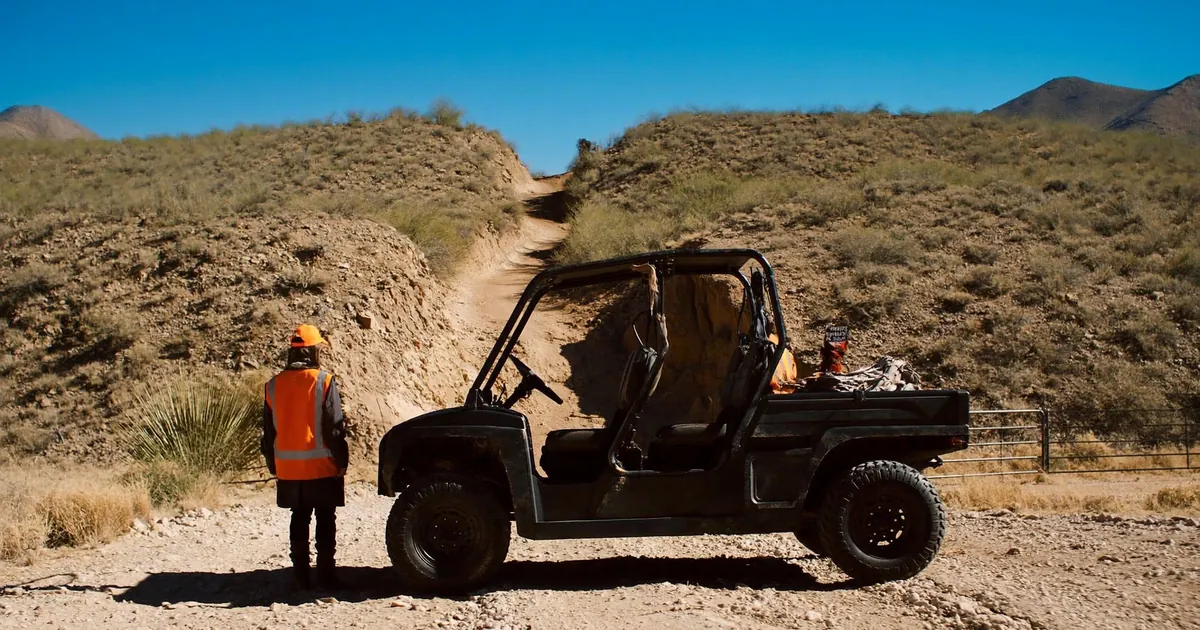
Hunting season out of El Paso means an early start and a long drive. Trucks loaded before dawn, headed east on Interstate 10 toward Sierra Blanca and Van Horn, north toward the Hueco Mountains, out to a lease in Hudspeth or Culberson County, or across the line into the units around Ruidoso. Somewhere at the end of that drive, a ranch gate opens and the last few miles get covered on an all terrain vehicle or a utility task vehicle loaded with gear.
Those last few miles are where a surprising share of hunting season injuries happen. Not from firearms. From vehicles. Rough two-track roads, loaded racks, cold hands, low light, unfamiliar terrain, and a machine with a high center of gravity that behaves very differently on a side slope than it does on flat ground.
A hunting season vehicle crash raises legal questions that a highway crash never does. Who owes you a duty when you are on someone else's ranch by permission? What happens when the machine itself failed? What if you were a passenger and the driver is a friend? This post walks through how Texas answers those questions.
Why Hunting Season Produces a Distinct Kind of Crash
The pattern in these cases is consistent, and it has almost nothing to do with recklessness in the ordinary sense.
The terrain is the hazard. Ranch roads have washouts, hidden ruts, loose caliche, arroyo crossings, and side slopes that were never engineered for anything. A vehicle that handles fine on a straight two-track can go over on a cross slope at walking speed.
The loads are wrong. Utility task vehicles get loaded with feed, water, blinds, coolers, and harvested game, often stacked high in the bed or strapped to a rack. Raising the center of gravity on a machine that is already tall is the single most common contributor to a rollover.
Riders exceed the design. An all terrain vehicle built and labeled for a single rider frequently carries two. A utility vehicle with two seats and two belts carries four people, with the extras sitting in the bed. When that vehicle rolls, the belted occupants often walk away and the unbelted ones do not.
Light is bad at both ends of the day. Hunting happens at dawn and dusk. That is also when depth perception is worst and when a rut, a rock, or a drop-off is hardest to see.
Nobody is wearing a helmet. On private land, Texas helmet requirements generally do not apply. A rollover at 15 miles per hour can still produce a serious head injury when there is nothing between the rider's head and the ground.
Help is far away. A crash forty minutes from a paved road, on property with no cell coverage, turns a survivable injury into a critical one. Response time is part of why these injuries are so severe.
What a Texas Landowner Actually Owes You
Most people assume that if they are hurt on someone else's property, the property owner is responsible. In Texas, and especially in hunting, that assumption is often wrong.
Texas premises liability starts with the visitor's status. An invitee who is on the land for the mutual benefit of both parties is owed ordinary care, including a duty to inspect for and warn about hazards the owner knew or should have known about. A licensee who is there by permission for their own purposes is owed less. A trespasser is owed almost nothing beyond a duty not to injure them willfully or through gross negligence.
Then the Texas recreational use statute changes the analysis again.
What the statute does. When a landowner gives permission to enter the land for recreation, and hunting is explicitly recreation under the statute, the law generally treats the visitor as a trespasser for liability purposes. Instead of ordinary care, the owner owes only a duty not to injure the visitor willfully, wantonly, or through gross negligence. That is a much higher bar than proving that a rancher should have filled in a washout.
Where it gets complicated. The protection is tied to what the landowner charges. The statute contemplates a limit on the total amount that can be collected before the protection is affected, and it treats landowners who carry liability insurance differently. Paid hunting leases, guided hunts, outfitters, and commercial operations are not automatically covered by the same shield that protects a rancher letting a neighbor hunt for free.
Gross negligence is not impossible to prove. Gross negligence means conduct involving an extreme degree of risk that the owner was actually aware of and proceeded with anyway. A known, unmarked, deep washout across a road that guests are directed to use is a very different fact pattern from an ordinary rough patch.
The practical takeaway is not that you have no case if you were hurt on a lease. It is that the analysis is different from a slip and fall at a grocery store, and it needs someone who knows the framework. Our premises liability practice works through exactly these questions.
When the Machine Is the Problem
A meaningful share of hunting season vehicle injuries are not caused by the terrain or the driver. They are caused by the vehicle.
Texas product liability law recognizes three kinds of defect:
Manufacturing defect. The product left the factory different from its own design. A weld that failed, an axle that fractured, a bolt that was never torqued.
Design defect. The design itself is unreasonably dangerous, and there was a safer alternative design that was economically and technologically feasible and would have prevented or significantly reduced the injury without substantially impairing the product's utility. Texas requires proof of that safer alternative, which is why these cases need an engineer early.
Marketing defect. The product needed a warning or instruction that it did not have, or the warning that existed was inadequate.
In off road vehicles, the recurring issues include rollover protective structures that fail or that were never installed, seat belts and occupant restraint systems that do not keep an occupant inside the protected zone, doors and nets that were optional when they should have been standard, steering and suspension component failures, throttle and brake defects, fuel system fires after a rollover, and tire failures on machines sold for terrain the tires were not rated for.
The evidence that decides these cases lives in the machine. Do not let it be repaired, sold, or scrapped. Photograph it where it sits, note the make, model, and vehicle identification number, and preserve it. A product liability claim is very difficult to prove once the vehicle is gone.
Passenger Injuries and Who Actually Pays
Some of the hardest conversations we have in these cases start with a version of the same sentence: the driver was my brother in law, and I do not want to sue him.
That instinct is understandable, and it usually rests on a misunderstanding of how these claims work. A claim against a negligent operator is almost always resolved through insurance, not out of that person's pocket. Depending on the circumstances, coverage might come from a homeowners policy, a farm and ranch policy, a separate off road vehicle policy, or a commercial policy if the hunt was guided or the vehicle belonged to a business.
A few things to understand as a passenger:
Your own comparative fault matters. Texas will reduce your recovery by your percentage of responsibility and bar it entirely above 50 percent. Riding in the bed of a utility vehicle, riding two-up on a single rider machine, or declining an available restraint all become arguments the insurer will make. They are arguments, not automatic answers, and how comparative fault works in Texas is worth understanding before you talk to an adjuster.
More than one party may be responsible. The operator, the landowner, the outfitter, the vehicle manufacturer, and a maintenance provider can all be in the picture. Identifying every source of coverage is often what makes a serious injury claim viable.
Guides, Ranch Hands, and Workers Who Get Hurt
Not everyone injured during hunting season is a hunter. Guides, ranch employees, wildlife managers, and camp staff are hurt on these same vehicles, and their analysis is different again.
Texas is unusual in that workers compensation is optional for private employers. Employers who carry it generally give up the right to be sued directly in exchange for a no-fault benefit system. Employers who opt out, known as non-subscribers, lose the key common law defenses, which substantially changes what an injured worker can recover.
If you were working when you were hurt, the first question is whether your employer was a subscriber. The answer changes everything about the path forward. Our workplace injury practice starts there.
What to Do After a Hunting Season Vehicle Accident
- Get the injured person out safely and call for help. Note the GPS coordinates or the nearest gate if you have any signal at all. In remote country, guiding responders in is the difference maker.
- Photograph the scene before anything moves. The vehicle position, the terrain, the slope, the rut or obstacle, the load in the bed, the restraints, and the light.
- Photograph the vehicle in detail. Make, model, vehicle identification number, roll structure, belts, tires, and any visible failure.
- Do not authorize repairs. The vehicle is the single most important piece of evidence in a defect case.
- Identify who owns the land and who owns the vehicle. They are frequently not the same person, and both matter.
- Get the names of everyone present. In hunting camps people scatter to four different towns the next day.
- Go to a hospital, not a clinic. Head, neck, and internal injuries from a rollover are routinely missed on a quick check.
- Call an attorney before you talk to any insurer. Landowner insurers and manufacturer representatives both move quickly, and both are gathering information for their own purposes.
Talk to Lovett & Murray About a Hunting Season Injury
Hunting season injury cases sit at the intersection of premises liability, product liability, and insurance coverage, and they usually involve a defense that starts by pointing at the recreational use statute.
Lovett & Murray has represented injured people in El Paso and across West Texas for more than 30 years. We handle serious injury cases, we work with the engineers and reconstruction experts these claims require, and we know how to preserve a machine before it disappears into a repair shop.
Consultations are free. We work on a contingency fee, which means you owe us nothing unless we win your case. Our team is bilingual in English and Spanish.
Contact us today or call 915-757-9999. If the vehicle from your crash still exists, the most valuable thing you can do today is make sure nobody touches it.
See our articles more often on Google.