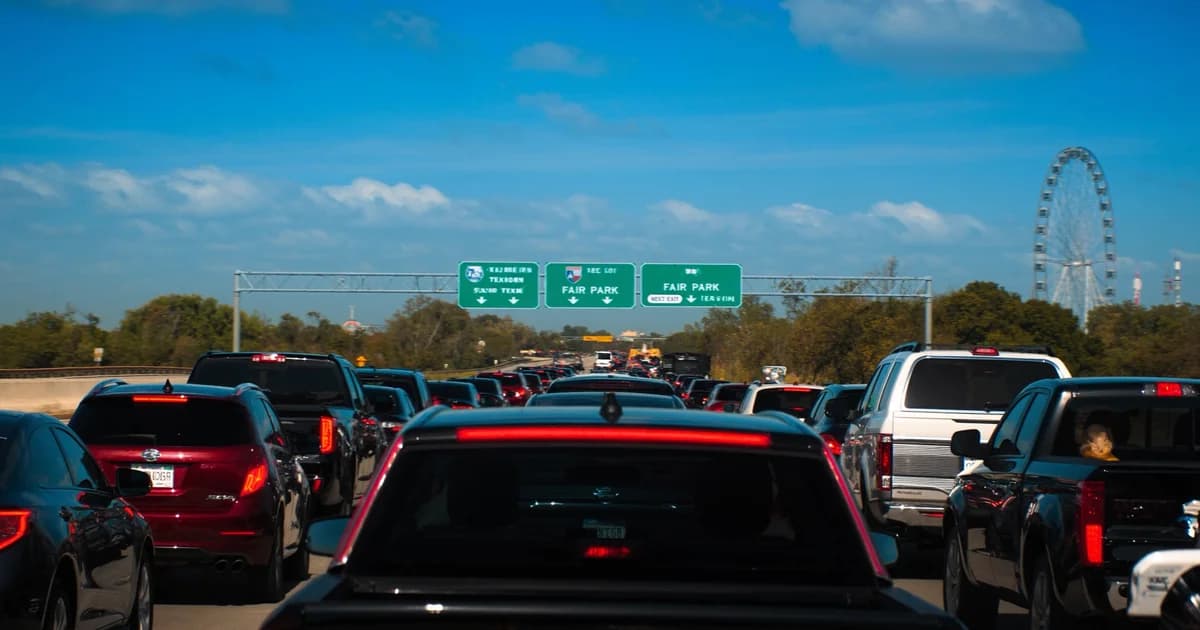
The drive from El Paso to the State Fair of Texas is the longest road trip most West Texas families take all year. You leave before sunrise on Interstate 10, watch the Franklin Mountains shrink in the mirror, and then settle in for nine or ten hours of Van Horn, Sierra Blanca, Fort Stockton, Odessa, Midland, and finally Interstate 20 all the way into Dallas. It is a beautiful drive. It is also one of the most demanding stretches of highway anyone in this state drives voluntarily.
Every year from late September through the middle of October, that corridor fills up. Families heading east for Fair Park. Students driving home for a long weekend. Commercial trucks running the same lanes they always run, now sharing them with thousands of drivers who are tired, unfamiliar with the route, and pushing to make it in one day.
If you are making that drive, or if you have already been hurt on it, this post covers what actually makes long-haul travel crashes different: why fatigue is a legal problem and not just a comfort problem, what happens to your claim when the wreck occurs three hundred miles from your doctor and your lawyer, and how to protect a case that has to be built across half of Texas.
Why the Drive East Out of El Paso Is Its Own Hazard
Most crash-risk conversations focus on congestion. The El Paso to Dallas corridor is the opposite problem. The danger is not too much happening, it is too little.
Monotony puts drivers into a low-alert state. Long, straight, visually repetitive highway is exactly the condition that produces what researchers call highway hypnosis. Drivers stay technically awake but stop scanning, stop checking mirrors, and lose track of the miles behind them. Reaction time drops well before anyone feels sleepy.
The gaps between services encourage pushing through. Between Van Horn and Fort Stockton there are long stretches with very little. Drivers who need a break talk themselves out of one because the next exit with a real rest stop is forty minutes out. That is how a five-minute stretch break becomes another two hours behind the wheel.
Speeds are high and the margin is thin. Much of Interstate 10 and Interstate 20 in West Texas carries a posted limit of 75 or 80 miles per hour. At those speeds a two-second lapse covers the length of two football fields. There is often no median barrier and no shoulder wide enough to recover in.
Everyone leaves and returns at the same time. Fair weekends compress travel into Friday mornings and Sunday evenings. Sunday evening is the worst combination of the season: drivers who woke up early, walked a fairground all day, and now face a nine-hour return trip into the dark with a deadline at work the next morning.
Fatigue Driving Is Negligence, Even Though Texas Has No Fatigue Statute
There is no ticket in Texas called driving while tired. That fact leads a lot of people to assume fatigue cannot be the basis of a claim. It can, and regularly is.
Texas negligence law asks a straightforward question: did the driver use the care an ordinarily prudent person would use under the same circumstances? A driver who has been awake for twenty hours, who has driven eight hours without a meaningful stop, or who felt themselves drifting and kept going anyway has not met that standard. The absence of a specific statute does not create permission. It just means the proof has to come from evidence rather than from a citation.
What that evidence usually looks like:
- Fuel and toll receipts that establish a timeline of continuous driving
- Cell phone records showing when the driver last stopped moving
- Text messages or social media posts about how early they left or how long they had been on the road
- Hotel records, or the absence of any
- The crash pattern itself, because fatigue crashes tend to involve no braking, no evasive steering, and a straight drift out of the lane
Commercial drivers are held to a documented standard. If the vehicle that hit you was a commercial truck, federal hours-of-service rules apply, and the carrier is required to keep records of duty status. Those records, along with electronic logging device data and engine control module downloads, can show precisely how long that driver had been working. They are also on a retention clock, which is one of the strongest reasons to get counsel involved fast in any commercial truck accident.
What Changes When You Crash Far From Home
A crash outside Odessa is legally the same event as a crash on Mesa Street. Practically, almost everything about handling it is different.
Your medical record starts somewhere else. You will be treated at a regional hospital, discharged with paperwork from a system your El Paso doctors cannot see, and sent home. Ask for a copy of everything before you leave, including imaging on a disc if they will give it to you. Then see a doctor in El Paso within a few days so your treatment record is continuous rather than a single out-of-town visit followed by silence.
Your vehicle stays behind. It gets towed to a yard near the crash site and it starts accruing storage fees immediately. Write down the wrecker company and the yard address at the scene. Before anyone repairs, releases, or crushes that vehicle, it needs to be photographed thoroughly, because the crush pattern, the airbag module, and the tire condition are all evidence.
The crash report comes from a different agency. Depending on where it happened, the investigating agency could be the Texas Department of Public Safety, a county sheriff, or a small-town police department. Reports take time to become available, and the request process is different for each. Getting the report is often the first step in identifying the responding trooper and any witnesses.
Witnesses scatter immediately. Everyone at a highway crash scene is on their way somewhere else. If you are able to, get names and phone numbers at the scene. A witness who lives in Midland and saw the whole thing is enormously valuable, and effectively unreachable if nobody wrote down their number.
Venue may not be El Paso County. Texas venue rules generally place a case either in the county where the incident occurred or where the defendant resides. That can mean a court hundreds of miles away. It is a manageable issue, but it is one more reason not to try to handle a long-haul crash claim alone.
Out-of-Town and Out-of-State Drivers
Fair season pulls traffic from everywhere, including New Mexico, Arizona, Oklahoma, and northern Mexico. When the driver who hit you is not from around here, a few things shift.
Coverage limits vary. Texas requires minimum liability coverage, and other states set their own minimums. Some are lower. If the at-fault driver carries a thin policy, the compensation available from their insurer may not come close to covering a serious injury. That is when uninsured and underinsured motorist coverage on your own policy carries the claim, and it is worth checking your declarations page before you travel.
Rental cars add a second layer. Fair-season travelers frequently drive rentals. A rental crash can involve the driver's personal policy, the rental company's coverage, and whatever supplemental product was sold at the counter. Sorting out which policy pays first takes time.
Service and jurisdiction take longer. An out-of-state defendant can generally be sued in Texas for a crash that happened in Texas, but locating and serving them adds weeks. Insurance companies know this and are not in a hurry.
Preserve the Case While the Evidence Still Exists
The single biggest difference between a long-haul crash claim and a local one is how quickly the proof disappears.
- Photograph everything at the scene if you are physically able. Vehicle positions, skid marks or the absence of them, debris field, road surface, signage, weather, and the light.
- Get the other driver's information completely. Name, address, phone, insurer, policy number, and a photo of the license and insurance card rather than a hand-copied version.
- Note the mile marker. On a rural interstate, the mile marker is the address. It determines which agency responded and which court has the case.
- Do not give a recorded statement. An adjuster may call within a day, often while you are still driving home or still in pain. You are not required to give a recorded statement to the other driver's insurer, and what you say in one is frequently used to reduce a claim later.
- Write down your own timeline that night. When you left, where you stopped, how long you had been driving, what you saw.
- Get counsel involved early. Preservation letters to a trucking company, a request for surveillance video from a truck stop, and a records request to an out-of-county agency all have to happen within weeks, not months.
Deadlines and Fault in a Texas Highway Crash
Texas generally gives you two years from the date of the injury to file a personal injury lawsuit. That is the outer limit, not a plan. Video from a fuel stop may be overwritten in thirty days. Commercial driver logs have their own retention periods. Waiting is the most common and most expensive mistake.
Fault also gets divided. Texas uses modified comparative fault with a 51 percent bar. If you are found partly responsible, your recovery is reduced by your percentage, and if you are found more than 50 percent responsible you recover nothing. Insurers lean on this hard in highway cases, where they will argue you were following too closely, driving too fast for conditions, or fatigued yourself. Understanding how comparative fault works in Texas is often the difference between a fair result and a discounted one.
Talk to Lovett & Murray About Your Long-Haul Crash
If you were hurt on the drive to or from the State Fair of Texas, or anywhere on the long stretch of Interstate 10 and Interstate 20 east of El Paso, our team can help you sort out where the case belongs, who pays, and what your claim is actually worth. We have been representing injured people in El Paso and across Texas for more than 30 years, and distance from home does not change what you are owed.
Consultations are free. We work on a contingency fee, which means you pay us nothing unless we win your case. Our team is bilingual in English and Spanish, and we handle the calls to the out-of-town wrecker yard, the records request to the sheriff's office two counties over, and the adjuster who keeps calling you.
Contact us today or call 915-757-9999. The sooner we start, the more of the evidence is still there to find.
See our articles more often on Google.