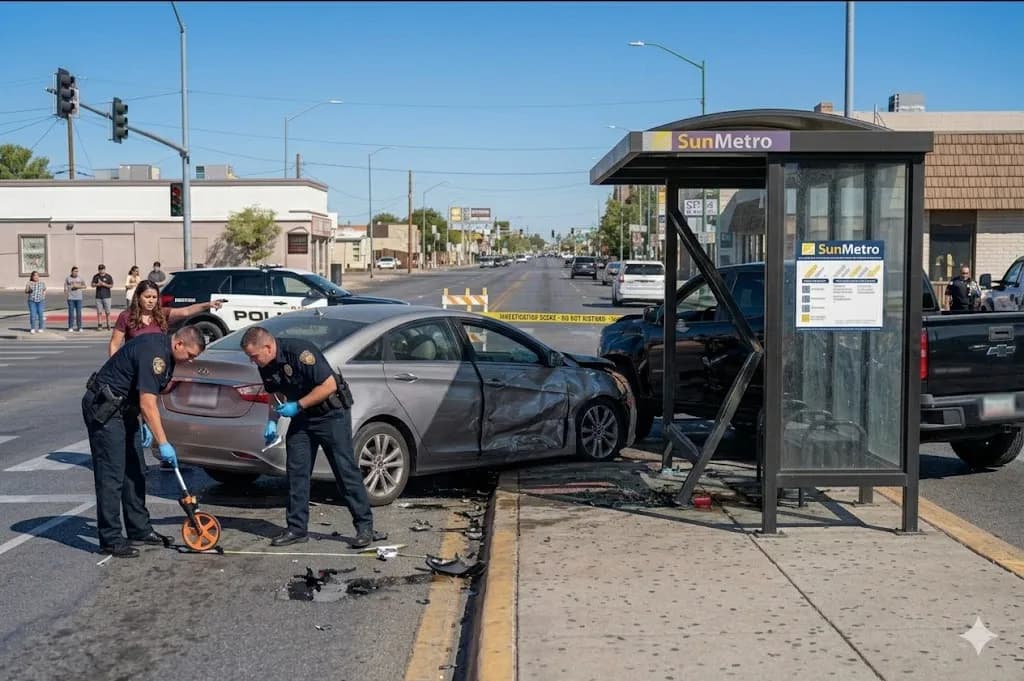
You are driving west on I-10 through El Paso, approaching the Downtown interchange, when traffic slows suddenly. You brake hard but not quite fast enough, tapping the bumper of the car ahead. At the same time, that driver had cut in front of you without signaling. Both of you share some responsibility for what happened. In Texas, that shared responsibility does not automatically disqualify you from recovering compensation, but it does change how much you can recover and how aggressively the insurance company will fight your claim.
Understanding how Texas comparative fault works is one of the most important things you can do to protect yourself after an accident in El Paso.
What Is Comparative Fault in Texas?
Texas follows what is called a modified comparative fault rule, codified in Section 33.001 of the Texas Civil Practice and Remedies Code. The core principle is straightforward: if you are partially at fault for an accident, your compensation is reduced by your percentage of responsibility. However, there is a hard cutoff. If you are found to be 51% or more at fault, you recover nothing.
This is sometimes called the "51% bar rule." It means you can be 50% at fault and still recover half of your damages. But the moment your fault tips to 51%, your claim is completely barred.
This rule applies to all personal injury cases in Texas, including car accidents, truck accidents, motorcycle crashes, pedestrian collisions, and slip-and-fall injuries.
How Fault Percentages Are Assigned
Fault is not determined by a single person or formula. In a settlement negotiation, the insurance adjuster assigns fault percentages based on the evidence. If a case goes to trial, the jury decides. The percentages must add up to 100% across all parties involved in the accident.
Evidence that influences fault assignment includes:
- Police reports from the El Paso Police Department or Texas DPS
- Traffic camera footage from intersections like Mesa and University or Montana and Airway
- Witness statements from other drivers or bystanders
- Physical evidence such as skid marks, vehicle damage patterns, and road conditions
- Cell phone records showing whether a driver was texting or distracted
- Traffic violations such as running a red light, speeding, or failing to yield
In El Paso, factors like sun glare on east-west roads during morning and evening commutes, construction zones on I-10, and the high speed limits on US-54 and Loop 375 all play into how fault is evaluated.
Real-World Shared Fault Scenarios
Comparative fault comes into play more often than most people realize. Here are examples that reflect situations El Paso drivers encounter regularly.
Both Drivers Ran a Yellow Light
Two drivers approach the intersection of Mesa Street and Schuster Avenue. Both try to clear the yellow light. They collide in the intersection. A jury might assign 50% fault to each driver. Under Texas law, each driver can still recover from the other, but their damages are cut in half.
Jaywalking Pedestrian Hit by a Speeding Car
A pedestrian crosses Montana Avenue mid-block instead of using the crosswalk near Cielo Vista Mall. A driver doing 50 in a 35 zone strikes the pedestrian. The jury might assign 30% fault to the pedestrian for jaywalking and 70% to the driver for speeding. The pedestrian can still recover 70% of their damages because their fault is well below 51%.
Rear-End Collision with a Brake Check
You are following a car on Airway Boulevard. The driver ahead brake-checks you aggressively. You rear-end them. While the following driver is typically presumed at fault in rear-end collisions, the brake-check shifts significant responsibility to the lead driver. A fair fault split might be 40% to you and 60% to them, allowing you to recover 60% of your damages.
Lane Change Collision on I-10
You are changing lanes on I-10 near the Sunland Park exit without checking your blind spot. At the same time, the car in the next lane is speeding. Both drivers share fault. If you are assigned 45% and the other driver 55%, you can still recover 55% of your damages.
How Insurance Companies Use Comparative Fault Against You
Insurance adjusters are trained to minimize payouts, and comparative fault gives them a powerful tool. Their goal is to push your fault percentage as high as possible, ideally past that 51% threshold where they owe you nothing.
Common tactics include:
- Recorded statements: An adjuster calls you days after the accident and asks leading questions designed to get you to admit fault or minimize the other driver's mistakes
- Seatbelt arguments: Even in clear-liability crashes, insurers argue that your injuries would have been less severe if you had been wearing a seatbelt, trying to assign fault for your injuries
- Pre-existing conditions: Insurers claim your injuries existed before the accident to reduce what they attribute to the crash
- Surveillance: Adjusters may monitor your social media or even conduct physical surveillance to find evidence that contradicts your injury claims
- Lowball offers: They offer a quick settlement before you understand the full extent of your injuries, knowing that once you sign, you cannot come back for more
This is why having an experienced personal injury attorney matters. An attorney fights back against inflated fault assignments and ensures the evidence supports an accurate picture of what happened.
Protecting Your Right to Recover
If you have been injured in an accident in El Paso and you believe you may share some fault, there are steps you can take to protect your claim.
Do not give a recorded statement to the other driver's insurance company without speaking to an attorney first. Anything you say can be used to increase your fault percentage.
Document everything at the scene. Photos of vehicle positions, traffic signals, road conditions, and weather can be critical in establishing what actually happened.
Get medical attention immediately. Delaying treatment gives the insurance company ammunition to argue your injuries are not serious or were not caused by the accident.
Preserve evidence. Dashcam footage, surveillance video from nearby businesses, and cell phone records can all be subpoenaed to support your version of events.
Know the statute of limitations. In Texas, you have two years from the date of the accident to file a personal injury lawsuit. Miss that deadline and you lose your right to recover entirely, regardless of fault.
Why the 51% Rule Makes Legal Representation Critical
In states with pure comparative fault, even a driver who is 99% at fault can recover 1% of their damages. Texas is not one of those states. The 51% bar creates a cliff where your entire claim disappears. Insurance companies know this, and they will aggressively argue that you were mostly at fault to eliminate their liability entirely.
The difference between being assigned 49% fault and 51% fault is not a 2% reduction in your recovery. It is the difference between receiving compensation and receiving nothing. That razor-thin margin is exactly why you need an attorney who understands how fault is argued, negotiated, and proven in El Paso courts.
Talk to an El Paso Personal Injury Attorney Today
If you have been injured in an accident and you are worried about shared fault, do not let the insurance company define the narrative. At Lovett & Murray, we have more than 30 years of experience fighting for injured people across El Paso and West Texas. We know how adjusters operate, we know how juries in this community evaluate fault, and we know how to build a case that protects your right to fair compensation.
Your consultation is free, and you pay nothing unless we win your case. Call us at 915-757-9999 or contact us online to discuss your situation today.
See our articles more often on Google.