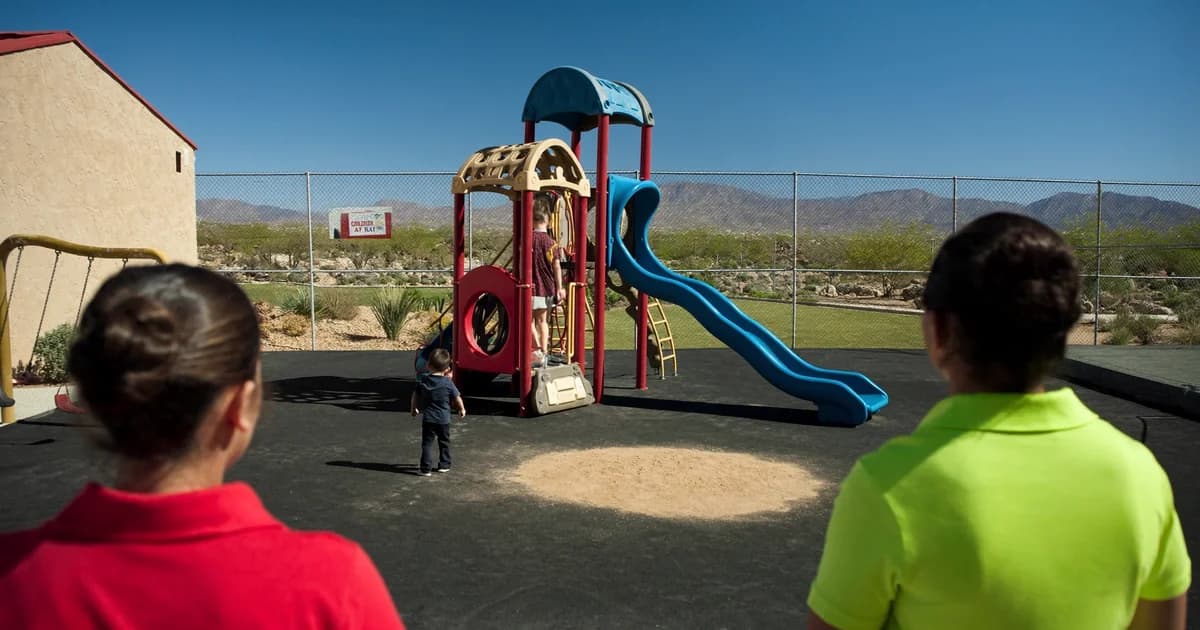
The last week of September is when El Paso families get their afternoons back. The mornings are cool enough for the playground at Memorial Park or Album Park, the after school programs are in full swing, and the play yards behind the centers along Montana Avenue, Dyer Street, and out in the Lower Valley fill up at three o'clock every day.
Most of the scrapes and bruises that come home are exactly what childhood is supposed to look like. Some are not. A fall from the top of a climber onto packed dirt, a head injury nobody watched happen, a burn from equipment that sat in the sun all afternoon, a broken arm that a parent hears about hours later with no explanation of how it occurred.
If that has happened to your family, you are probably being told it was an accident and that these things happen. Sometimes that is true. Often it is not, and the difference comes down to supervision, surfacing, and maintenance, all three of which are governed by standards that a licensed operation is required to meet. This article explains what Texas requires of child care operations, how these claims are actually built, why the identity of the property owner changes the deadlines dramatically, and what you should document this week.
What Texas Requires of a Licensed Child Care Operation
Child care operations in Texas are licensed and regulated by the Texas Health and Human Services Commission, which publishes minimum standards that licensed centers and registered homes must follow. Those standards address, among other things:
- Caregiver to child ratios and maximum group sizes, which vary by the age of the children and by the activity.
- Supervision requirements, including what active supervision means during outdoor play, water activities, transitions, and naps.
- Playground and equipment conditions, including resilient surfacing under equipment, equipment maintenance, and hazards such as entrapment and entanglement points.
- Incident and injury reporting, including when a facility must notify a parent and when it must notify the state.
- Caregiver qualifications and training, including background checks.
Two things parents should know about those standards. First, inspection and violation histories for licensed operations are public records, and a documented pattern of prior citations for the same problem is powerful evidence that the risk was known. Second, meeting the minimum standard is not automatically the same as acting reasonably. A center can be within ratio and still be negligent if the supervision it actually provided was not adequate for what those children were doing at that moment.
Supervision Is the Heart of Most Daycare Injury Claims
When a child is hurt in a play yard, the question is almost never whether children fall. It is whether an adult was in a position to prevent this particular thing.
Where the caregivers were. Standing together at the fence talking is a different fact than being distributed among the equipment. Where staff were physically positioned relative to the climbers, the swings, and the gate is usually the central fact.
How many children, and which ages. Mixed age play multiplies risk. A toddler on equipment designed for school age children is a foreseeable injury, not a freak one.
Whether the activity called for closer watching. Water play, climbing structures, and any activity near a driveway or parking area require closer supervision than free play on open ground.
Whether it was known behavior. Repeated aggression by another child that the facility knew about, and did not address, can support a claim when the next incident causes real injury.
How long before anyone noticed. Delay tells you about supervision more clearly than almost anything else. A child who sat with a broken bone for an hour was not being watched.
Related claims often accompany the supervision claim: negligent hiring, negligent training, and negligent retention of a caregiver the operation knew or should have known was unfit.
Surfacing, Fall Zones, and Equipment
Playground injuries are largely a matter of physics, and the surface decides how a fall ends.
Fall height and surfacing. Widely used playground safety guidance calls for shock absorbing surfacing of an appropriate depth under and around equipment, extending through the whole fall zone. Engineered wood fiber, rubber tiles, poured surfacing, and sand all have specifications. Compacted dirt, worn mulch that has migrated away from the base of a slide, asphalt, and grass do not meet them. When a child falls from a climber onto a surface that has not been maintained, the surfacing is frequently why an ordinary fall became a fracture or a concussion.
Heat. In El Paso this is not a minor point. Metal slides, dark rubber surfacing, and uncoated equipment can reach temperatures that cause contact burns on a sunny afternoon well into the fall. Shade structures, surface selection, and simply keeping children off hot equipment are all part of reasonable care here in a way they are not in other parts of the country.
Equipment condition and design. Broken welds, protruding bolts, missing guardrails, worn swing hangers, and openings that can trap a head or a limb are maintenance failures. Ropes, cords, and drawstrings create strangulation risk. If a component failed rather than being worn out, there may also be a product liability claim against the manufacturer.
Layout and access. Unfenced play areas near traffic, gates that do not latch, and equipment placed too close together are design and premises problems. These are ordinary premises liability questions, and a child at a facility their family pays is generally an invitee, which is the highest duty a property owner owes.
Who You Are Actually Making a Claim Against
This determines your deadlines, so establish it first.
- A private daycare or after school program. An ordinary negligence and premises claim against the business, and often its franchisor or property owner as well.
- A registered child care home. Same framework, but coverage is frequently thin, so identifying every applicable policy matters.
- A church or nonprofit program. Generally a private claim, though some organizations have limited statutory protections that need to be analyzed.
- A school district playground. El Paso Independent School District, Ysleta Independent School District, and Socorro Independent School District are governmental entities. Claims involve immunity, damage caps, and a notice deadline typically measured in months.
- A city or county park. Governmental immunity again, plus the Texas recreational use statute, which can reduce the duty owed on land open for recreation to the duty owed a trespasser. Those claims are difficult, not impossible.
- A child development center at Fort Bliss. Federal facilities follow an entirely separate administrative claims process with its own forms and deadlines. If your child was hurt on post, see our page for military personnel and their families and get advice quickly.
The Deadlines Are Not What Most Parents Assume
Parents frequently hear that a child has until adulthood to bring a claim and conclude there is no hurry. Be careful with that.
A minor's own claim is generally tolled. In Texas, the limitations period for a child's personal injury claim is generally suspended until the child turns 18, which usually leaves until around age 20 to file. That protection is real.
Your own claim is generally not tolled. A parent's claim for the child's medical expenses is typically subject to the ordinary two year period described in our guide to the Texas statute of limitations.
Government claims still require fast notice. If a school district, a city, a county, or another governmental entity is involved, formal written notice is generally required within six months, and a home rule city can shorten that. Tolling for minors does not rescue a missed notice.
Evidence does not wait for anyone. Surveillance video is usually overwritten within weeks. Staff turn over. Playground surfacing gets refilled, and broken equipment gets replaced or removed, which is good for the next child and bad for proving what happened to yours.
What to Document This Week
- Photograph everything, immediately. The equipment, the surfacing directly under it including a hand pushed into it for depth, the fall zone, the fencing and gates, the shade, and the general layout. Return the same day if you can.
- Ask for the incident report in writing and take a photograph of it before you leave.
- Write down names. Which staff were present, who found your child, who called you, and how long after the injury that call came.
- Ask other parents. Someone at pickup may have seen it, and other families sometimes report similar problems at the same facility.
- Get your child medically evaluated, and tell the provider how it happened. Head injuries in young children in particular need evaluation even when the child seems fine.
- Keep the clothing and any broken item, unwashed and unaltered.
- Do not sign a release, and do not accept an offer to cover a copay in exchange for signing anything. An offer to settle quietly is usually made before anyone has seen the records.
A note on waivers: Texas courts have been skeptical of a parent's ability to waive a child's future negligence claims, so an enrollment packet you signed a year ago is not necessarily the end of the discussion.
Talk to Lovett & Murray About Your Child's Injury
No parent wants to be adversarial with the people who watch their child every day, and most of these conversations start with a family who simply wants a straight answer about what happened. Getting that answer usually requires the incident report, the staffing records for that hour, the inspection history, and the video, and those are not things a facility volunteers.
For more than 30 years, Lovett & Murray has represented El Paso families in serious injury claims, including injuries to children. We offer a free consultation. We work on contingency, so you pay no attorney fee unless we win. Our team is bilingual in English and Spanish, and our office is here in El Paso, close enough to send a preservation letter before the video is gone.
If your child was hurt at a daycare, an after school program, or a playground, contact us for a free case evaluation or call 915-757-9999. Start with a conversation. You are not committing to anything by asking.
See our articles more often on Google.