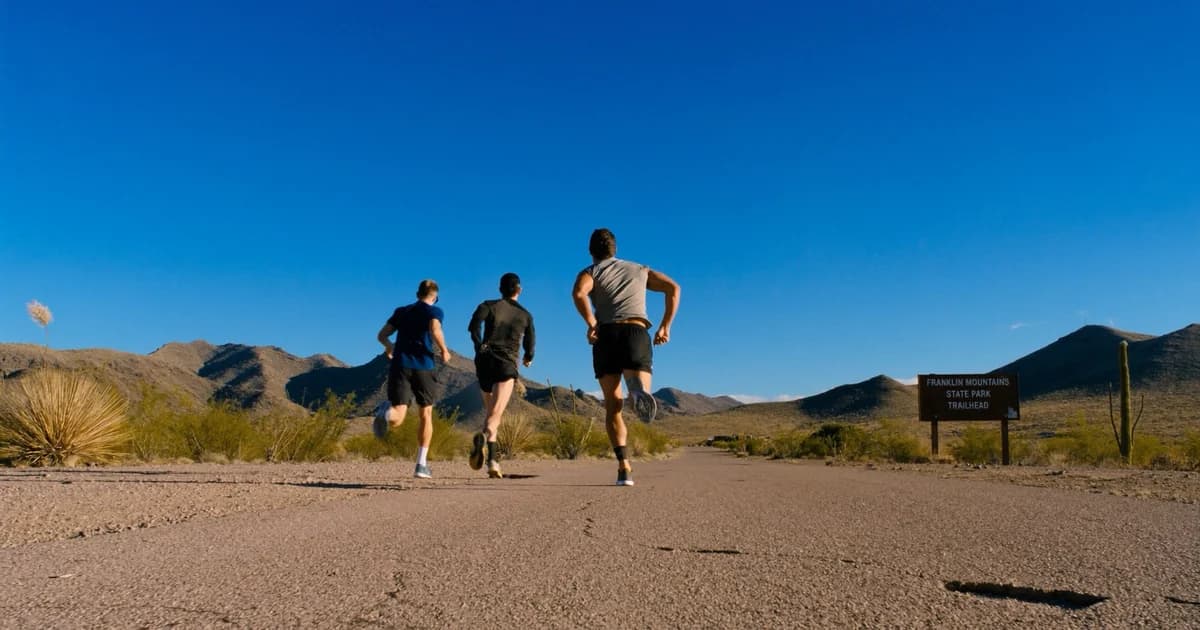
The best running season in El Paso starts right about now. The monsoon has broken the heat, the mornings finally drop into a range where you can put in miles, and the training plans for winter and spring races begin in earnest. Before sunrise you will find runners on the levee path along the Rio Grande, on the loop at Memorial Park, climbing Scenic Drive toward the overlook, working the shoulder of Transmountain Road, and on the desert singletrack in Franklin Mountains State Park.
You will also find them in places nobody designed for running. On the edge of Mesa Street where the sidewalk simply ends. Crossing an arterial in the dark because the nearest signal is half a mile away. On broken sidewalk in older neighborhoods where the pavement has been lifting for a decade.
Runners get hurt in El Paso every training season, and when it happens the legal picture depends almost entirely on one question: where were you when it happened. A crash on a public street is a straightforward negligence claim. The same injury on a park trail may run into a statute that reduces the duty owed to you all the way down to the duty owed to a trespasser. This article covers driver duties to runners, how trail and sidewalk claims work in Texas, why public land is the hardest category, and what to do in the days after you are hurt.
Where El Paso Runners Actually Get Hurt
Roadway strikes at dawn and dusk. Early morning and evening training overlaps with commute traffic and with the worst light of the day. Runners on the shoulders of Transmountain Road, Mesa Street, and the long arterials are exposed to drivers who are not expecting a person there.
Crossings. Mid block crossings on Montana Avenue, Alameda Avenue, and Dyer Street are where the serious pedestrian injuries happen, because those are wide, fast roads with signals spaced far apart.
Parking lot and driveway conflicts. A driver pulling out of a shopping center on Zaragoza Road or Sunland Park Drive is looking left at traffic, not right at the sidewalk.
Trail surface failures. Washouts after monsoon storms, undercut edges, exposed rebar and pipe at drainage crossings, missing bollards, and unmarked drop offs on the levee and canal paths.
Park and facility hazards. Broken track surfaces, unlit paths, missing handrails on stairs, and unsecured equipment or maintenance vehicles on shared paths.
Sidewalk defects. Vertical separations, sunken utility cuts, and heaved slabs, which cause a disproportionate number of the wrist, shoulder, and facial injuries runners suffer.
Dogs and other trail users. Off leash dogs, cyclists, and electric scooters on shared paths.
Drivers Owe Runners a Duty, Even Outside a Crosswalk
Insurers open runner cases by arguing the runner should not have been in the road. Know what the law actually says.
Texas Transportation Code section 552.006 requires a pedestrian to use a sidewalk where one is provided and it is practical to do so. Where there is no sidewalk, a pedestrian walking along a roadway should use the left shoulder, facing oncoming traffic. Running with traffic on a road with no sidewalk gives an insurer something to argue about, so if you have a choice, face traffic.
At intersections, section 552.003 generally requires drivers to yield to a pedestrian in a crosswalk on the driver's half of the roadway or approaching closely from the other half. That includes unmarked crosswalks at intersections, which most drivers do not realize exist. Outside a crosswalk, the pedestrian yields.
None of that ends the analysis. Texas law separately requires every driver to exercise due care to avoid colliding with a pedestrian, to sound the horn when necessary, and to use proper precaution around children and obviously confused or incapacitated people. A runner who was where the law says they should not have been still has a claim. The fault is apportioned, and Texas modified comparative fault lets you recover as long as you are not more than 50 percent responsible, with your recovery reduced by your share. Our overview of pedestrian accidents in El Paso explains how these arguments usually play out.
If the driver leaves, do not assume the case is over. Report it immediately, look for cameras, and check your own auto policy, because uninsured motorist coverage in Texas can apply to a pedestrian struck by a hit and run driver. Our guide to hit and run accidents in El Paso walks through it.
Where You Were Standing Decides Which Law Applies
This is the part that determines whether a trail or sidewalk case is viable.
Private property. A gym, a private track, a commercial trail, or a shopping center sidewalk is an ordinary premises liability claim. Your legal status controls the duty owed. An invitee, meaning someone on the property for the owner's benefit, is owed the highest duty: the owner must make safe or warn of dangerous conditions it knew about or should have discovered through reasonable inspection.
City, county, or state property. A city park, the Ascarate Park loop, a county road, or a state park trail brings in governmental immunity, the Texas Tort Claims Act, and a notice deadline measured in months.
Public streets and sidewalks. Usually the city, though the adjacent property owner or a contractor working the area may share responsibility, and a state highway right of way belongs to the Texas Department of Transportation.
Identify the correct owner first. Sending notice to the wrong entity is the same as sending no notice at all.
The Texas Recreational Use Statute Is the Real Obstacle
Most people who are hurt on a public trail have never heard of this, and it is usually the whole case.
The Texas recreational use statute applies when a landowner allows people to use the land for recreation, which includes hiking and similar activities, generally without charging a fee. When it applies, the law treats the person using the land as a trespasser for purposes of the duty owed. Practically, that means ordinary negligence is not enough. You generally have to show gross negligence, or a willful, wanton, or malicious act.
That is a demanding standard, and it is deliberate. The statute exists to encourage landowners, including cities and the state, to keep land open to the public without absorbing unlimited liability for it.
It is not, however, an automatic loss:
Gross negligence is a real standard, not an impossible one. It generally involves a condition that carries an extreme degree of risk, where the responsible party had actual, subjective awareness of the risk and proceeded with conscious indifference. A hazard reported repeatedly and never addressed, or a known washout left unmarked and unbarricaded on a heavily used path, can support that argument.
Not every injury is a recreational use case. The statute has limits, and whether it applies depends on the land, the activity, and the circumstances. That analysis is worth doing carefully rather than assuming the door is closed.
Other defendants may not get the protection. A contractor who left an excavation open, a utility that failed to secure a vault lid, or a private event organizer may face ordinary negligence standards even where the landowner does not.
Public Land Also Adds a Notice Deadline Measured in Months
If a governmental entity is potentially responsible, the calendar becomes the most urgent part of the case.
The Texas Tort Claims Act generally requires formal written notice of a claim within six months of the incident, and a home rule city may shorten that period through its own charter or ordinances. The notice must reasonably describe the injury, the time and place, and the incident. A phone call to a parks line or a report through a service app is not statutory notice.
Runners are especially likely to miss this. A serious ankle, knee, or shoulder injury often looks survivable for the first few weeks. People rehab, wait to see whether they can get back to training, and only later realize they are dealing with something surgical. By then the notice window can already be closed.
Dogs, Waivers, and the Injuries Nobody Plans For
Dog attacks. A Texas bite claim generally depends on showing the owner knew the animal had dangerous tendencies. A separate negligence claim can be built on the failure to restrain the animal, including a violation of a local leash requirement, and that route often works when a loose dog charges a runner who is hurt falling, even without a bite. See our summary of Texas dog bite laws.
Group runs and organized events. Waivers are common and they matter, but a waiver is not unlimited. Texas courts apply specific requirements to liability releases, and a waiver rarely covers gross negligence.
What to Do After You Are Hurt on a Run
- Call 911 for any vehicle contact. A report created at the scene is very hard to recreate later.
- Photograph the hazard immediately, with something in frame for scale, plus the wider approach and the lighting. Trail washouts get graded and sidewalk defects get patched.
- Note exactly where you were. Trail name, nearest mile marker or cross street, and which side of the road.
- Identify the owner. City park, county park, state park, and private trail are four different legal situations.
- Get medical care the same day, and tell the provider how it happened, not just what hurts. That narrative becomes part of the record.
- Save your watch data. Pace, route, and time stamps from a running watch or phone are unusually good evidence of where you were and how fast you were moving.
- Do not give a recorded statement, and do not post the run publicly before you talk to a lawyer.
Talk to Lovett & Murray About Your El Paso Running Injury
Runner cases get dismissed too early, by insurers and sometimes by the runners themselves. People assume that being in the road was their fault, or that nothing can be done about a trail that failed under them. Neither assumption is reliable. What is reliable is that the deadlines on public land are short and the physical evidence disappears quickly.
For more than 30 years, Lovett & Murray has represented injured people throughout El Paso County, from pedestrians struck on the arterials to families dealing with serious injuries on public property. We offer a free consultation. We work on contingency, so you pay no attorney fee unless we win. Our team is bilingual in English and Spanish, and our office is here in El Paso.
If you were hurt training on an El Paso road, sidewalk, or trail, contact us for a free case evaluation or call 915-757-9999. Call before you find out how long you will be off your feet.
See our articles more often on Google.