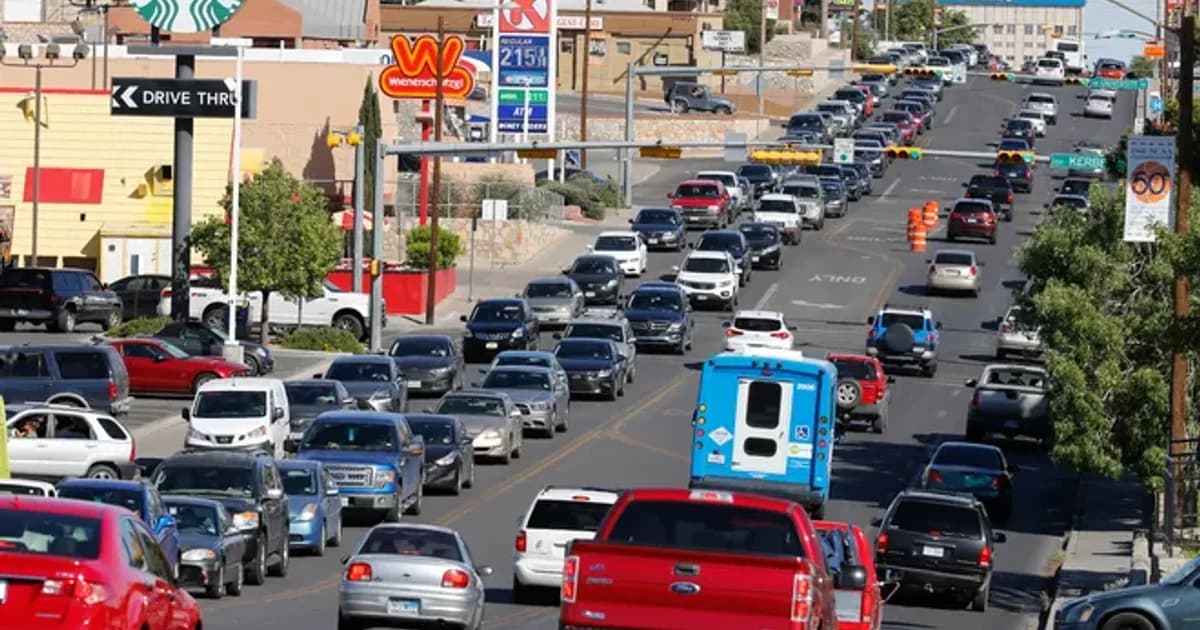
Seven hours before kickoff, Sun Bowl Drive is already a slow river of pickup trucks with grills in the beds. Tailgaters have staked out the lots off Glory Road. The streetcar is running loops down Oregon Street through Kern Place, and Mesa Street is backed up from the university all the way toward the Interstate 10 ramps. Football at the University of Texas at El Paso, known to everyone here simply as UTEP, turns a mountainside campus into one of the densest mixes of vehicles and people that El Paso sees all year.
That density is the risk. A UTEP game day compresses tens of thousands of people, a full day of drinking, unfamiliar out of town drivers, narrow campus roads carved into the Franklin Mountains, and a mass exit that all happens in about twenty minutes. Pedestrians cross wherever the crowd flows. Drivers back out of tight spaces into moving lanes. And after the game, some of the people driving home down Mesa Street or onto Interstate 10 should not be driving at all.
If you were hurt on a game day, the legal picture is more complicated than a normal crash, because the location determines the rules. A wreck on Mesa Street is a standard Texas auto claim. The same wreck 300 yards away in a campus lot may involve a state institution and a six month notice deadline. This article covers where the risk concentrates, what your rights are as a pedestrian, how parking lot and tailgate claims work, and what to do before you leave the stadium.
Why Game Day Around the Sun Bowl Is Its Own Kind of Hazard
The Sun Bowl sits in a bowl. The roads that feed it, Sun Bowl Drive, Glory Road, Robinson Avenue, University Avenue, and the Schuster Avenue corridor, were not designed for stadium volume, and the terrain limits how traffic can be rerouted.
Everyone arrives over hours and leaves at once. Arrival is spread across an afternoon. Departure is a single pulse. That asymmetry is why postgame is when the serious crashes happen.
Pedestrians and vehicles share the same space. People walk in the roadway because the sidewalk is full. Drivers creep forward because they cannot see past the vehicle ahead. Every one of those interactions is a near miss waiting to become a claim.
Drivers do not know the campus. Visiting fans, ride share drivers chasing a surge, and El Pasoans who never drive Sun Bowl Drive otherwise are all making decisions on unfamiliar, steep, curving roads.
Alcohol is present all day. Tailgating starts in the morning. By the fourth quarter, a meaningful share of the people walking to their cars have been drinking for eight hours.
Light changes fast. A September game that kicks off in the afternoon ends near dusk, and low sun on the west facing slopes above campus is a real visibility problem on the drive out.
Pedestrians Have Rights on Sun Bowl Drive, and Drivers Have Duties
Pedestrian claims are the most misunderstood part of a game day injury, and drivers frequently talk their way out of responsibility by telling an officer the person "came out of nowhere."
Texas Transportation Code section 552.003 generally requires a driver to yield the right of way to a pedestrian who is in a crosswalk on the driver's half of the roadway or approaching closely enough from the other half to be in danger. That applies to marked crosswalks and to unmarked crosswalks at intersections, which is a distinction most people do not know exists.
Outside a crosswalk, the pedestrian must yield to vehicles. But that is not the end of it. Texas law separately requires every driver to exercise due care to avoid colliding with a pedestrian, to sound the horn when necessary, and to exercise proper precaution around a child or an obviously confused or incapacitated person. A pedestrian who crossed midblock in a crowd does not lose the right to make a claim. Fault gets apportioned, and under Texas modified comparative fault you can still recover as long as you are not more than 50 percent responsible, with your recovery reduced by your share.
Practically, in a crowd, comparative fault turns on details: whether the driver was moving through a pedestrian mass, how fast, whether the driver was looking at a phone or a parking attendant, whether the crowd was being funneled into the roadway by barricades. Our overview of pedestrian accidents in El Paso covers how these fault fights usually go.
Parking Lot and Tailgate Lot Crashes
Lot crashes feel minor and often are not. A backing vehicle striking a person at low speed still breaks hips, knees, and wrists, and the injured person is often walking away from a tailgate with their hands full.
Backing drivers owe the duty. A driver backing out of a space must yield to traffic already moving in the lane and to pedestrians. When two vehicles back into each other, fault is usually shared, and how it is split depends on who entered the lane first.
There may be no police report. Officers sometimes decline to write a report for a private property collision. Ask anyway, and if no report is created, document the scene yourself as if you were the officer. Photograph both vehicles where they stopped, before anyone moves them.
Tailgate hazards are premises questions. Uneven pavement, missing wheel stops, unlit lots, open trenches, propane and grill hazards, and unmanaged crowd flow are all premises liability issues. In Texas, the duty owed depends on your status as an invitee, licensee, or trespasser, and a ticketed fan on the property is generally an invitee, which is the highest duty.
Tent and equipment injuries have an owner. A canopy that blows over, a generator, a portable grill, or a truck mounted television is somebody's property, and that somebody may carry homeowners or commercial insurance that responds.
Get the plate before you get sympathy. Hit and run happens constantly in game day lots, because people are drinking and afraid. Our guide to hit and run accidents in El Paso explains what to do when the other driver disappears, including how your own uninsured motorist coverage can apply.
When Alcohol Is Part of the Crash
A game day crash caused by an impaired driver opens more than one avenue of recovery, and the extra avenues are frequently where the real coverage is.
The driver. The standard auto liability claim, limited by whatever policy the driver carries.
A licensed alcohol provider. Under the Texas Dram Shop Act, a bar, restaurant, or stadium concessionaire can be liable if it served someone who was already obviously intoxicated to the point of presenting a clear danger to themselves and others, and that intoxication caused the harm. The proof is in tabs, point of sale timing, server testimony, and security video from the bars near campus and along Mesa Street. That video usually lives on a short overwrite loop, so a preservation letter in the first week matters enormously.
A social host, in narrow circumstances. Texas social host liability is much more limited than dram shop liability. The clearest situation involves an adult who provides alcohol to a minor under 18. Given how many tailgates include high school aged siblings and recruits, this is worth asking about.
The criminal case against the driver is separate from your civil claim, and you should not wait for it. Our summary of Texas driving while intoxicated laws and penalties explains how the two tracks differ.
Claims Involving the University Follow Government Rules
This is the part that surprises people. The University of Texas at El Paso is a state institution, which means it is a governmental unit. If your claim is against the university itself, for example over a dangerous condition on campus property or a university vehicle, it runs through the Texas Tort Claims Act.
Three consequences:
The categories of allowed claims are limited. The Act waives immunity only in specific circumstances, and many theories that would work against a private stadium operator simply are not available.
Damages are capped. Recovery against a governmental unit is limited by statute regardless of how serious the injury is.
Notice is due fast. Formal written notice of the claim is generally required far sooner than the two year limitations period, often within six months. There is no forgiveness for a late notice in most cases, even for a badly injured person who was focused on recovering.
If your injury happened on campus property, on a campus road, or involved a university vehicle or employee, treat the calendar as the emergency. It usually is.
What to Do Before You Leave the Stadium
- Call 911 and insist on a report, even for a lot collision. Say whether you believe alcohol is involved.
- Photograph vehicle positions before anything moves, then the damage, then the wider scene including light poles, signs, barricades, and lot markings.
- Look up for cameras. Campus buildings, parking structures, and nearby businesses have them. Note exactly where they are so a preservation letter can go to the right place.
- Get witnesses now. Game day witnesses scatter within minutes and many are from out of town. Names, phone numbers, and where they were standing.
- Ask who was working. Parking attendants, security staff, and event contractors are witnesses and their employers may be responsible parties.
- Get medical care the same day. Adrenaline and alcohol both mask injuries, and a same day record connects the injury to the crash.
- Decline the recorded statement. You are not required to give one.
Talk to Lovett & Murray About Your Game Day Injury
Game day cases are layered. There may be a driver, a bar, an event contractor, a property owner, and a state institution with a six month notice clock, all in one file. Sorting out which of them is actually responsible, and which of them has coverage that matters, is the work.
For more than 30 years, Lovett & Murray has represented injured people throughout El Paso County, from pedestrians struck near campus to families dealing with a serious crash on the way home. We offer a free consultation. We work on contingency, so you pay no attorney fee unless we win. Our team is bilingual in English and Spanish. And our office is here in El Paso, close enough to get preservation letters out to campus and to the bars on Mesa Street while the video still exists.
If you or someone in your family was hurt on a UTEP game day, contact us for a free case evaluation or call 915-757-9999. Do not wait to see how you feel in a month. The deadline that matters most may already be running.
See our articles more often on Google.