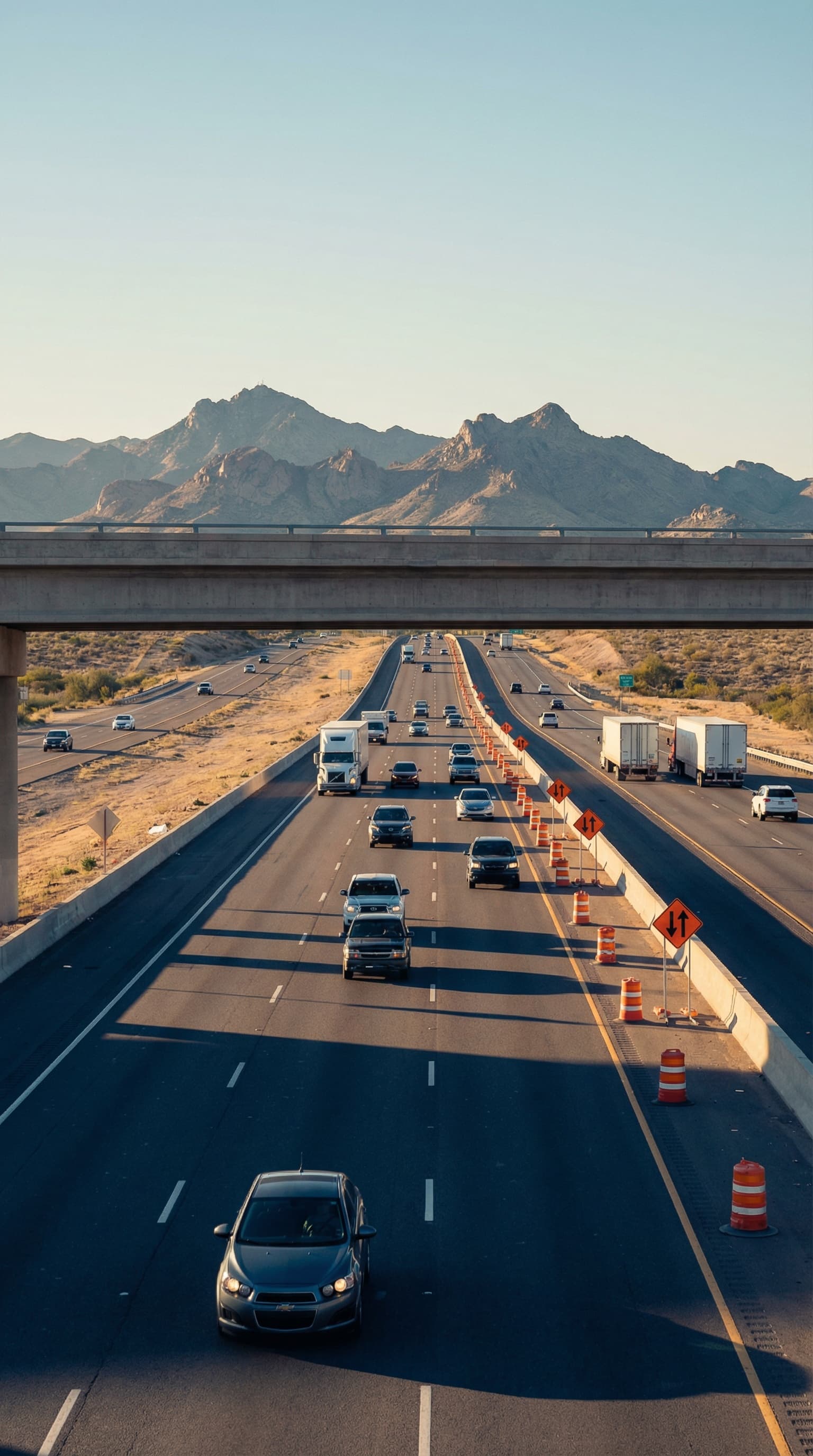
If you drive I-10 through El Paso, you already know the drill. Orange barrels, shifted lanes, concrete barriers appearing overnight, and speed limits that change from one block to the next. The ongoing widening and reconstruction projects along I-10 from Downtown through the West Side have turned the city's most-traveled highway into a patchwork of construction zones that seems to have no end in sight.
These construction zones are also some of the most dangerous stretches of road in the region. Narrowed lanes, sudden merges, confusing detour signs, and reduced speed limits create a perfect storm for serious accidents. When a crash happens in a construction zone, the question of who is responsible is often more complicated than a typical highway accident.
Why I-10 Construction Zone Crashes Are So Common in El Paso
El Paso sits at one of the busiest crossroads in the Southwest. I-10 is the primary east-west corridor connecting the city to Las Cruces, Phoenix, San Antonio, and Houston. Every day, tens of thousands of passenger vehicles share the highway with commercial trucks, military convoys from Fort Bliss, and cross-border traffic.
Layer active construction on top of that volume and the result is predictable. The factors that make I-10 construction zones so crash-prone include:
Sudden lane shifts and closures. Drivers traveling at highway speeds encounter lane closures with little warning, especially at night or during off-peak hours when new traffic patterns are implemented. The transition from a three-lane highway to a single-lane squeeze between concrete jersey barriers demands full attention, and many drivers are not prepared.
Reduced sight distance. Barriers, equipment, and temporary walls restrict how far ahead you can see. A driver who cannot see a backup until the last moment may not have enough stopping distance to avoid a rear-end collision.
Speed differential. Posted speed limits in I-10 construction zones typically drop to 45 or 55 mph, but many drivers continue at 65 or 70. The speed difference between compliant drivers and those who ignore the reduced limits is one of the most common causes of construction zone crashes.
Nighttime work. Many I-10 construction projects operate at night to reduce daytime traffic disruptions. Reduced visibility, temporary lighting, and driver fatigue combine to increase accident risk significantly during overnight hours.
Merging confusion. Temporary merge points, closed on-ramps, and shifted interchange geometry create confusion, particularly for drivers who are unfamiliar with the current layout or who rely on GPS that has not been updated to reflect the construction changes.
Texas Construction Zone Traffic Laws and Enhanced Penalties
Texas takes construction zone safety seriously, and the law reflects that. Under Texas Transportation Code Section 542.404, traffic fines are automatically doubled when a violation occurs in an active construction or maintenance zone where workers are present. This means a speeding ticket that would normally cost $200 could cost $400 in a construction zone.
Beyond enhanced fines, drivers who cause accidents in construction zones due to speeding, following too closely, or failing to obey posted signs can face additional civil liability. If a construction zone accident results in serious injury or death, the at-fault driver may face criminal charges including reckless driving or criminally negligent homicide.
Texas law also requires drivers to:
- Obey all posted construction zone speed limits
- Merge safely and in the sequence indicated by signs
- Yield to construction vehicles and flaggers
- Maintain a safe following distance, which should be increased in construction zones due to frequent stops and slow traffic
- Move over or slow down when approaching construction workers near the roadway
Ignoring these rules in a construction zone does not just put you at risk of a ticket. It creates the conditions for catastrophic accidents that can involve multiple vehicles, construction workers, and heavy equipment.
Common Types of Construction Zone Accidents
Construction zones on I-10 produce several distinct types of crashes, each with its own pattern of injuries:
Rear-end collisions are the most frequent. Traffic that is flowing at highway speed suddenly stops or slows dramatically at the edge of a construction zone. A driver who is following too closely, distracted, or not aware of the speed reduction may slam into the vehicle ahead at full speed. These are often chain-reaction pileups involving multiple vehicles.
Sideswipe crashes happen when lanes narrow and barriers leave little room for error. Drivers merging into a single lane, especially alongside large trucks, can clip adjacent vehicles when the margin shrinks from a full lane width to inches.
Head-on collisions occur when temporary lane configurations route opposing traffic closer together than normal, sometimes separated only by cones or delineators rather than solid barriers. A momentary lapse in attention can send a vehicle into oncoming traffic.
Truck accidents are particularly dangerous in construction zones. An 18-wheeler that cannot stop quickly enough when traffic backs up can cause devastating multi-vehicle crashes. The narrow lanes also make it difficult for large trucks to maneuver safely, increasing the risk of sideswipe and rollover accidents. If a commercial truck was involved in your construction zone accident, the trucking company and their insurers may also bear responsibility.
Crashes involving construction workers and equipment represent some of the most serious construction zone accidents. When a vehicle breaches the work zone perimeter, workers on foot have almost no protection. These accidents often result in fatalities or catastrophic injuries.
Who Is Liable in an I-10 Construction Zone Crash?
This is where construction zone accidents differ significantly from typical car accidents. While another driver may be clearly at fault for speeding or tailgating, other parties could share liability:
The construction company has a duty to design and maintain a safe work zone. If they failed to place adequate signage, used confusing lane markings, did not install proper barriers, or left debris in the travel lanes, they may be liable for accidents that result.
Subcontractors who handle specific aspects of the construction, such as traffic control, signage, or barrier placement, may bear independent liability if their negligence contributed to the crash.
Government agencies that designed or approved the traffic control plan may be liable if the plan was inherently dangerous or failed to meet federal Manual on Uniform Traffic Control Devices (MUTCD) standards. Note that claims against government entities in Texas have special procedural requirements and shorter deadlines.
Other drivers who speed through the zone, ignore merge signs, or drive while distracted remain liable for the crashes they cause.
In many construction zone accidents, multiple parties share fault. An experienced attorney can investigate the scene, review the traffic control plan, and determine every party whose negligence contributed to your injuries.
Steps to Take After a Construction Zone Accident
If you are involved in a crash in an I-10 construction zone, take these steps to protect your health and your legal rights:
- Move to safety if possible. Construction zones have limited shoulder space and ongoing traffic. If your vehicle is drivable, move it out of the active lanes. Turn on hazard lights immediately.
- Call 911. Report the accident and request EMS if anyone is injured. The police report will document the construction zone conditions, which is critical evidence for your claim.
- Document the construction zone. Photograph the lane configuration, signage, barriers, speed limit signs, pavement markings, and any debris or hazards. Capture the condition of the work zone as it existed at the time of the crash, because construction companies can change the layout quickly.
- Get witness information. Other drivers and construction workers who witnessed the accident can provide valuable testimony about conditions in the zone before and during the crash.
- Seek medical attention promptly. Even if you feel fine, get evaluated. Construction zone crashes often involve high-speed impacts that can cause internal injuries, concussions, and spinal damage that may not present symptoms immediately.
If your injuries occurred while you were working in or near the construction zone, you may also have a workplace injury claim in addition to a personal injury claim against the at-fault driver.
Injured in an I-10 Construction Zone? Get Legal Help Now
I-10 construction zone accidents are among the most complex personal injury cases in El Paso. Identifying the responsible parties, navigating government liability rules, and proving that a construction company failed to maintain a safe work zone all require experienced legal representation.
Lovett & Murray has been fighting for accident victims in El Paso and across West Texas for more than 30 years. We have the resources and experience to investigate construction zone crashes, retain engineering experts, and hold every responsible party accountable, whether that is a negligent driver, a construction company, or a government agency.
We work on a contingency fee basis. You pay nothing unless we recover compensation for you.
Contact Lovett & Murray today for a free consultation about your I-10 construction zone accident. Call 915-757-9999 or reach out online. Our bilingual team is here to help you understand your rights and take the next step toward recovery.
See our articles more often on Google.