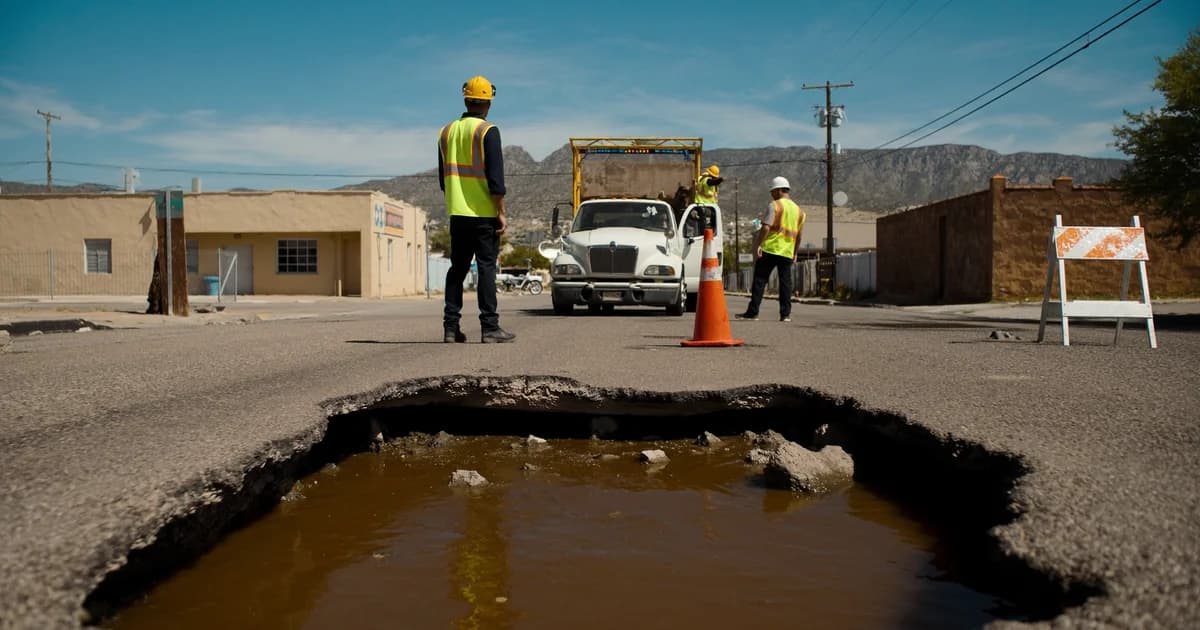
The first real monsoon storms hit El Paso in July, and by mid September the damage is fully visible. Water gets under the asphalt on Alameda Avenue, the base softens, and the pavement gives way. Dyer Street and Montana Avenue develop edges you can feel through the steering wheel. Interstate 10 through the central corridor picks up the seams and drop offs that come from a summer of heat followed by weeks of runoff. Out toward Socorro and Horizon City, shoulders wash out and the drop from pavement to dirt gets steep enough to catch a tire.
Most of the time a pothole costs you an alignment and a bad afternoon. Sometimes it costs a lot more. A deep hole at highway speed can blow a tire, pull a vehicle across a lane, or send a motorcycle down. A washed out shoulder can flip a truck. And a driver who swerves to miss a crater can end up in the next lane over.
When that happens, the claim is not like a normal car accident, because the party responsible for the road is usually a government entity with legal immunity that has only been partially waived. This article explains who owns which roads in El Paso County, how the special defect doctrine works and why it decides most of these cases, why the notice deadline is measured in months rather than years, and what evidence actually proves that a government entity knew about the hazard before it hurt you.
Why El Paso Roads Break Apart After Monsoon Season
Desert pavement fails in a specific way, and it explains the seasonal timing of these crashes.
Summer surface temperatures soften the asphalt binder. Then monsoon rain arrives fast and heavy, runs across pavement that cannot absorb it, and finds every crack. Water works its way into the base layer under the road. Traffic pounds the softened, saturated surface, and the base gives way. What starts as a crack in July is a hole by September.
The same cycle affects the things around the road: undercut shoulders, scoured pavement edges near arroyos and drainage crossings, sunken utility cuts and manhole collars, and loose gravel washed onto the roadway at low water crossings in the east and lower valley. Any of those can cause a crash, and each may belong to a different responsible entity.
Figure Out Who Owns the Road Before You Do Anything Else
This step decides everything that follows, including which deadline applies to you.
- Texas Department of Transportation. State highways, including Interstate 10, Loop 375 and the Border Highway, US 54 through the northeast, and the state maintained portions of Transmountain Road. Claims here are against a state agency.
- City of El Paso. City streets and arterials inside the city limits, including most of Mesa Street, Montana Avenue, Dyer Street, and Alameda Avenue where they run through the city, plus city traffic control and city maintained drainage.
- El Paso County. Roads in unincorporated areas, including many stretches out toward Canutillo, Fabens, and the far east county.
- Smaller municipalities. Socorro, Horizon City, San Elizario, Anthony, and Vinton maintain their own streets and have their own charters.
- A private contractor. In an active work zone, the contractor and its traffic control subcontractor may be responsible for the surface, the signage, and the transition between old and new pavement. Contractor claims are ordinary negligence claims with no governmental immunity and no damage caps, which makes them very different.
- A private property owner. A pothole in a shopping center lot off Zaragoza Road or Sunland Park Drive is a premises liability claim against the owner, not a government claim.
Getting this wrong is not a technical error. If you send notice to the city about a hazard that belongs to the state, the correct entity never receives notice, and the deadline runs out while you wait for an answer.
The Special Defect Doctrine Decides Most Pothole Cases
Under the Texas Tort Claims Act, when your claim is based on the condition of a road, the duty the government owes you depends on how the hazard is classified. This is the single most important legal question in a pothole case.
Ordinary premises defect. The governmental unit owes you only the duty a private landowner owes a licensee. In practice that means you have to prove the entity had actual knowledge of the dangerous condition, that you did not know about it, and that it failed to warn you or make it safe. Actual knowledge is a demanding standard. It is not enough that the hazard existed or that a reasonable inspection would have found it.
Special defect. The Act treats certain conditions differently. A special defect is an unexpected and unusual danger of the same general kind as an excavation or obstruction on a highway, road, or street. When a hazard qualifies, the entity owes you the duty owed to an invitee, which means it can be liable for a condition it knew about or reasonably should have known about. That is a dramatically easier case.
Texas courts decide this on the specific facts, and the factors that matter are the size and depth of the hazard, whether it spans or blocks the lane an ordinary driver would use, whether it presents an unexpected danger to a driver paying normal attention, and how long it had been there. Courts have often concluded that a routine pothole is not a special defect, and have been more willing to find one where the roadway was substantially obstructed or the drop off was severe. A washed out shoulder, a sunken utility cut deep enough to swallow a wheel, or a lane spanning crater is a much stronger candidate than a chipped patch.
There are also carve outs worth knowing. Claims based on the absence, condition, or malfunction of traffic signs, signals, and warning devices are treated separately under the Act, and discretionary decisions about road design are generally protected. The practical takeaway is that the way your claim is framed matters as much as the facts.
The Notice Deadline Is the Reason Most of These Claims Die
Texas gives you two years to file most personal injury lawsuits, and our explanation of the Texas statute of limitations covers how that works. A claim against a governmental entity does not get two years of breathing room.
The Texas Tort Claims Act generally requires formal written notice of the claim within six months of the incident. A home rule city can shorten that window through its own charter or ordinances, and many Texas cities have. The notice has to reasonably describe the injury, the time and place, and the incident itself.
Three things people get wrong:
A phone call is not notice. Reporting a pothole to a service line, or telling an adjuster what happened, does not satisfy the statute. Notice is a formal written document delivered to the right office.
The clock does not wait for your treatment to finish. People routinely wait to see whether a back injury resolves before calling a lawyer. In a government claim, six months of waiting is the whole case.
There is an exception, and you should never count on it. Formal notice is not required when the governmental unit already has actual, subjective awareness of its fault in producing the injury. That is a narrow, heavily litigated exception, and no responsible attorney would plan a case around it.
If a government entity may be involved, the calendar is the emergency. Call within days.
Proving the Entity Knew About the Hazard
Whether your case requires actual knowledge or constructive knowledge, the proof looks similar, and almost all of it is in government records that have to be requested.
- Prior complaints. Resident reports to a city service line or online request system, and complaints routed through a council office, create a paper trail with dates.
- Maintenance and work orders. Records showing the hazard was reported, inspected, scheduled, patched, or patched repeatedly at the same location are powerful. A location that has been repaired three times is not a surprise to anyone.
- Prior crashes. Other collisions at the same spot suggest the danger was known and ongoing.
- Your own photographs. Take them the same day if you can. Include a reference object for scale, the position of your vehicle, the surrounding lane markings, and any barricades, cones, or warning signs, including their absence.
What to Do in the First Days After a Road Defect Crash
- Call 911 and get a report, and make sure the officer's narrative describes the road condition, not just the vehicles.
- Photograph the hazard before it is repaired. Cities patch reported potholes quickly, and once it is filled, the evidence is gone. Photograph it from multiple angles and from a distance that shows the approach a driver would have had.
- Note the exact location. Cross street, direction of travel, lane, and if possible a mile marker or the nearest address.
- Get medical care the same day. The same rules apply as in any crash, and our guide to what to do after a car accident walks through it.
- Preserve the vehicle and the tire. In a blowout or wheel damage case, the physical evidence matters. Do not let a repair shop discard the parts.
- Do not give a recorded statement, and be careful about describing your own speed or attention before you understand how comparative fault in Texas will be argued against you.
- Call a lawyer immediately. Not after your treatment ends. Immediately.
Talk to Lovett & Murray About Your El Paso Road Defect Claim
Road defect claims are among the most procedurally unforgiving cases in Texas. There is a question of which entity is responsible, a question of how the hazard is legally classified, a notice deadline measured in months, statutory damage caps, and records that only come out through formal requests. Handled correctly, these claims are winnable. Handled slowly, they are usually over before anyone looks at the merits.
For more than 30 years, Lovett & Murray has represented injured people across El Paso County, from Interstate 10 collisions to serious injury claims involving dangerous road conditions. We offer a free consultation. We work on contingency, so you pay no attorney fee unless we win. Our team is bilingual in English and Spanish, and our office is here in El Paso, not in an out of state call center.
If a pothole, a washed out shoulder, or a broken road surface caused your crash, contact us for a free case evaluation or call 915-757-9999. The notice clock started the day it happened.
See our articles more often on Google.