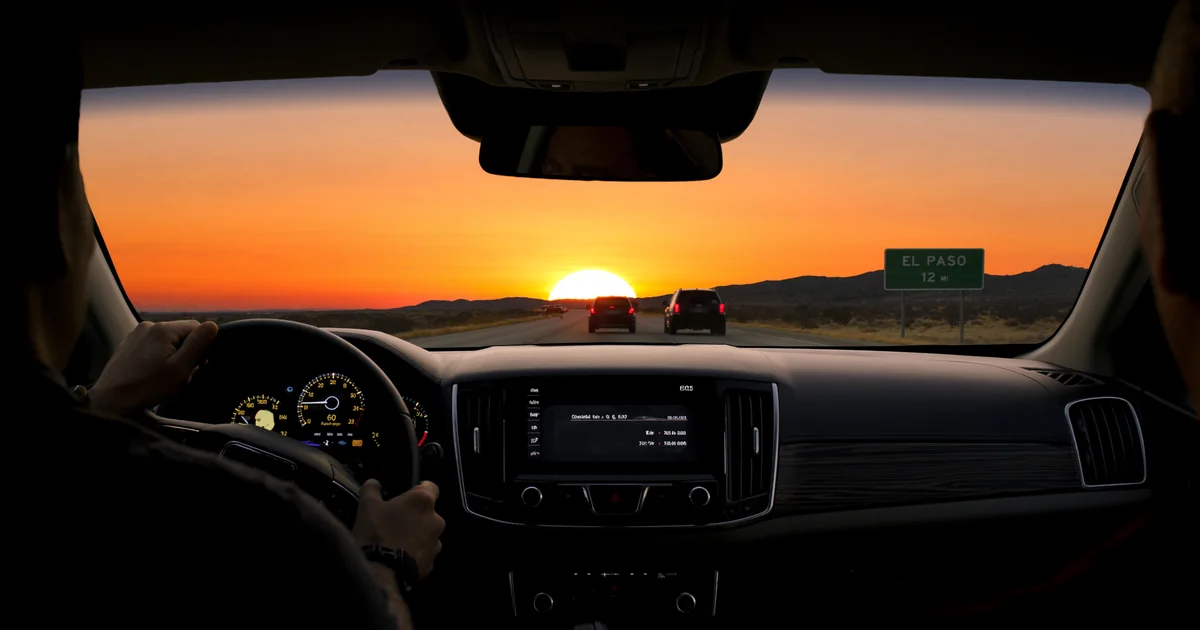
For most of the year, the sun comes up over the Hueco Mountains at an angle that misses the road. Then late September arrives, and for about two weeks it comes up almost exactly due east and goes down almost exactly due west. In El Paso, that is the same direction as Interstate 10. It is the same direction as Montana Avenue, Alameda Avenue, and the long east west runs of Loop 375. For those two weeks the sun sits low and directly in the windshield of the eastbound commute at 7 in the morning and the westbound commute at 7 in the evening.
Drivers here notice it as an annoyance. Visor down, squinting, following the taillights ahead because that is all you can see. What most people do not notice is that they are driving into a blind spot the size of a city block at highway speed, in traffic, with a windshield still hazed from monsoon season dust.
If a glare crash hurt you, the other driver almost certainly told the officer that the sun was in their eyes. This article explains why the equinox weeks are genuinely different from the rest of the year, where glare concentrates in El Paso, why "the sun blinded me" is not a defense under Texas law, and how fault in these crashes is actually proven when both drivers were looking into the same light.
Why the Equinox Sun Is Different From Every Other Week of the Year
This is geometry, not folklore, and it is worth understanding because it also tells you when the risk ends.
On the equinox, the sun rises due east and sets due west everywhere on earth. In the weeks on either side, it is close enough that the effect is the same. Every other month of the year the sun rises and sets noticeably north or south of that line, so it clears the roadway at an angle and the visor does its job.
Three things stack up in late September:
The alignment. El Paso's street grid and its main highway run east and west. When the sun is on that same axis, it is not off to the side. It is straight ahead.
The timing. Sunrise and sunset land close to the hours people commute, so the low sun and the traffic peak overlap.
The angle. A sun that is 5 or 10 degrees above the horizon is below the visor and above the dashboard. There is nowhere to put it.
Add a windshield with a summer of dust, wiper haze, and rock chips, and the glare scatters across the whole glass instead of coming through as a single bright point. That is the difference between uncomfortable and genuinely blind.
Where Glare Concentrates in El Paso
- Interstate 10. Eastbound in the morning, westbound in the evening, through the central corridor and out past the Spaghetti Bowl. High speed, heavy merging, and no room to slow down without being rear ended.
- Montana Avenue and Alameda Avenue. Long, straight, east west arterials with frequent signals, driveways, and pedestrian crossings. The combination of glare and unprotected left turns is a specific hazard.
- Loop 375 and the Border Highway. East west segments carry the same alignment problem at higher speeds.
- Roads climbing toward the Franklin Mountains. Grade changes shift your angle to the sun as you drive, so glare can appear suddenly at a crest.
- The Zaragoza and Ysleta corridors. Heavy commercial traffic mixing with commuters, plus port related truck volume that does not slow for visibility.
Our earlier piece on sun glare crashes on Interstate 10 in El Paso covers the corridor specific risks in more detail.
Texas Law Does Not Accept "The Sun Was in My Eyes"
This is the point that surprises the other driver, their insurer, and sometimes the investigating officer.
Texas Transportation Code section 545.351 requires a driver to operate at a speed that is reasonable and prudent under the circumstances then existing, and it separately requires a driver to control speed as necessary to avoid colliding with another person or vehicle on or entering the highway. The law is written around conditions, not around ideal conditions.
Sun glare is a foreseeable condition. It happens at the same hours, on the same roads, on a schedule anyone can look up. It is legally closer to rain or fog than to a deer jumping out of the dark. A driver facing reduced visibility is expected to slow down, increase following distance, use the visor, keep the windshield clean, and if visibility is truly gone, pull over safely and wait.
There is a narrow doctrine in Texas called sudden emergency, which can excuse a driver who reacts reasonably to an unexpected situation they did not cause. Glare almost never qualifies, because it is neither sudden nor unexpected to a driver who has been heading into a rising sun for the last ten minutes.
So when a driver tells the officer the sun blinded them, they have usually just admitted they were operating a vehicle they could not see out of. That statement belongs in the crash report, and it is worth making sure it gets there.
How Fault Is Proven When Everyone Was Looking Into the Same Light
Glare cases are won with objective evidence, because both drivers have a plausible story and neither one saw much.
Sun position analysis. The sun's azimuth and elevation for a specific date, time, and location are calculable. Compare that to the direction of travel and the roadway geometry, and you can establish whether the sun was actually in the driver's field of view, or whether the claim is a convenient excuse.
Video. Dashcams, business security cameras along the arterials, transit and commercial fleet cameras, and doorbell cameras near residential crossings. Most of this is on a short overwrite loop, so it has to be requested in the first days.
Event data recorders. Most modern vehicles record speed, braking, throttle, and steering input in the seconds before impact. If a driver who claims they were blinded never touched the brake, that tells you they did not slow down for a condition they say they could not see through.
Physical evidence. The presence or absence of skid marks, the impact angle, and the resting positions all constrain the story. A total absence of pre impact braking is significant.
Phone records. Glare is a common cover for distraction. In a serious case, phone activity around the time of impact is discoverable.
Witnesses. Other drivers in the same conditions can describe how bad the glare actually was at that spot and time, which cuts both ways and is worth knowing early either way.
When More Than One Party Is Responsible
Not every glare crash is a two driver case.
Commercial vehicles and their employers. A company that dispatches drivers into known glare hours, or that skips windshield maintenance across a fleet, may face responsibility beyond the individual driver. Delivery, rideshare, and freight operations all run through the exact hours in question.
The vehicle ahead. A disabled vehicle in a live lane, a truck merging slowly onto Interstate 10, or a driver stopping for a turn without signaling can each contribute.
Road conditions and obstructions. Missing lane markings, faded striping that becomes invisible in glare, and obscured signage can all be part of the picture, though claims involving roadway conditions bring in government notice deadlines that run much faster than the normal two year limitations period.
Sorting out who else is responsible matters, because in a serious injury case one driver's minimum liability policy will not cover the losses.
Rear End and Pedestrian Crashes in Glare Conditions
Two patterns dominate.
Rear end collisions. The driver behind has a duty to maintain a safe following distance and to be able to stop for traffic ahead. Reduced visibility raises that duty rather than lowering it. Glare is rarely a useful defense for the trailing driver, though it can become an argument about whether the lead driver stopped abruptly without reason.
Pedestrian strikes. These are the worst outcomes of the equinox weeks. A person crossing Montana Avenue or Alameda Avenue at 7 in the evening is invisible to a westbound driver much sooner than the driver realizes. Texas requires drivers to yield in marked and unmarked crosswalks at intersections, and separately requires every driver to exercise due care to avoid colliding with a pedestrian regardless of where the person is. Our overview of pedestrian accidents in El Paso explains how these fault fights usually run.
What to Do After a Sun Glare Crash
- Call 911 and get a report. Tell the officer the direction you were traveling and the time, and if the other driver blames the sun, make sure that statement is recorded.
- Photograph the light. Stand where the driver was and photograph what they were looking at, right then. That image is not reproducible later.
- Note your heading and the exact time. Direction of travel plus time stamp is what makes a sun position analysis possible.
- Look for cameras on nearby businesses and note their locations before you leave.
- Get medical care the same day. Delay in treatment is the first thing an adjuster uses against you.
- Do not speculate about your own visibility to an adjuster before you understand how comparative fault in Texas will be argued.
Talk to Lovett & Murray About Your Sun Glare Crash
Glare cases get treated as unavoidable accidents, and they are not. They are ordinary negligence cases with an unusually strong objective evidence trail, if someone gathers it while it still exists. The video is on a loop, the vehicle data has to be preserved, and the light itself only looks that way for a few weeks.
For more than 30 years, Lovett & Murray has represented injured people across El Paso County in car accident claims of every kind, from Interstate 10 pileups to pedestrians struck on the arterials. We offer a free consultation. We work on contingency, so you pay no attorney fee unless we win. Our team is bilingual in English and Spanish, and our office is here in El Paso.
If a driver who could not see hit you this September, contact us for a free case evaluation or call 915-757-9999. The sun being in someone's eyes is not the end of your claim. It is usually the beginning of it.
See our articles more often on Google.