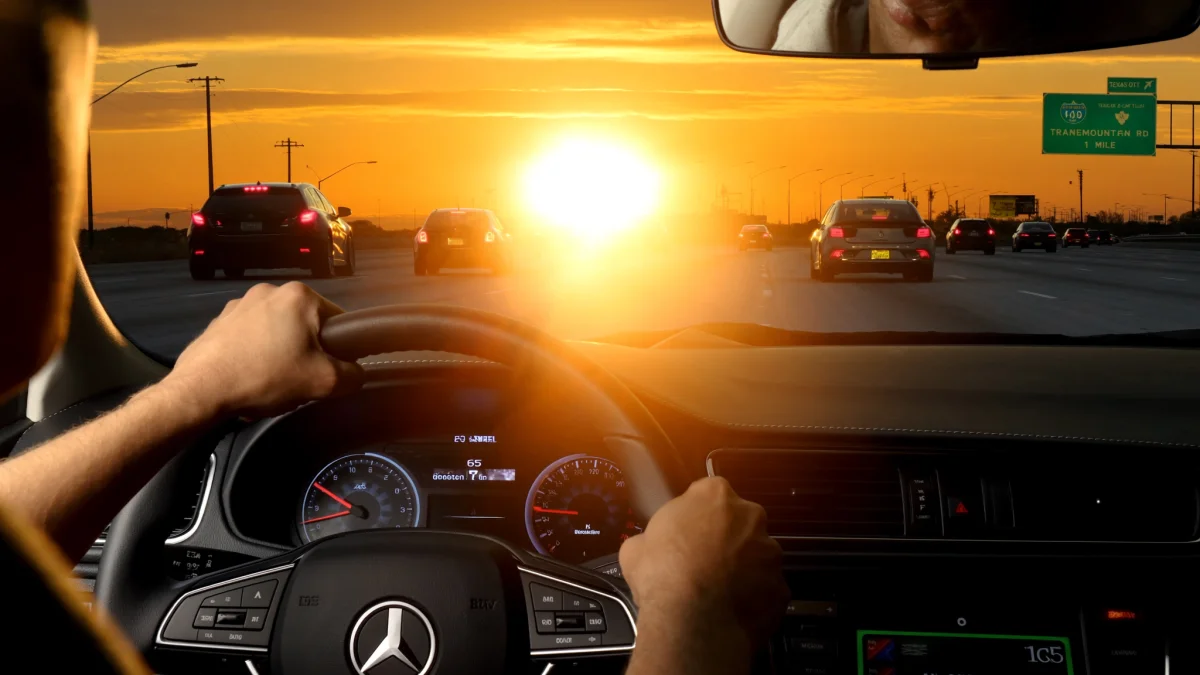
The sun rises over the Hueco Mountains at 6:42 AM in early August. By 7:00 AM, every eastbound lane of I-10 is jammed with commuters heading from Sunland Park, the West Side, and Las Cruces toward jobs in downtown El Paso, the Northeast, and Fort Bliss. And for those forty-five minutes, the sun sits almost exactly on the horizon ahead of them, blasting through windshields and turning the entire highway into a sheet of white light.
This is the most predictable, the most preventable, and the most underreported cause of August crashes on El Paso's main artery. Sun glare on I-10 East kills people every year. Most drivers do not realize they are driving in a measurable visibility hazard until they are inches from the brake lights of the car in front of them. If you commute eastbound on I-10 between Sunland Park and Loop 375 during the morning rush, here is what you need to know about the danger and your legal rights if a glare crash takes you down.
Why August Sun Glare Is So Dangerous on I-10
El Paso's geography produces a perfect storm for morning sun glare. I-10 runs nearly due east through the city. The Franklin Mountains sit to the north of the highway, the Mexican Sierra to the south, and the rising sun in August comes up at an azimuth of about 75 to 80 degrees, which is almost exactly aligned with the highway's east-west axis.
The result, between roughly 6:30 and 8:00 AM:
The sun sits low and directly ahead. A rising sun is far more dangerous than midday glare because it hits the eye at an angle that no standard sun visor can block. The visor stops light from above. The morning sun comes in below or beside the visor.
Brake lights and turn signals disappear. Red and amber light from the vehicle ahead is overwhelmed by the much brighter sunlight. A driver may not see brake lights until they are already on top of the slowing vehicle.
Lane markings wash out. White paint on dark asphalt is visible in normal light. In peak glare, the contrast collapses and drivers can drift across lanes without realizing it.
Pupils contract. Bright sunlight causes the iris to constrict, which reduces depth perception and contrast sensitivity for several seconds even after the eye looks away. Drivers checking mirrors or instruments cannot fully recover their forward vision during the brief glances back at the road.
Temperature exhaustion compounds. August dawn temperatures in El Paso are already in the high 70s. Drivers with malfunctioning air conditioning or who left a hot car parked overnight are dealing with heat fatigue in addition to glare.
The National Highway Traffic Safety Administration tracks sun glare as a contributing factor in approximately 4,000 crashes per year nationwide. In El Paso, the actual number is likely higher because state troopers often record sun glare crashes simply as "rear-end" or "failure to control" without noting the visibility condition.
The Daily Glare Windows on El Paso Highways
The danger windows are predictable enough to plan around. The peak glare hours on the major El Paso corridors:
| Highway | Direction | August Peak Glare |
|---|---|---|
| I-10 | Eastbound | 6:45 to 8:00 AM |
| I-10 | Westbound | 6:30 to 7:30 PM |
| US-54 (Patriot Freeway) | Southbound | 7:15 to 8:00 AM |
| US-54 (Patriot Freeway) | Northbound | 6:00 to 7:00 PM |
| Loop 375 (Transmountain) | Eastbound | 6:45 to 8:00 AM |
| Loop 375 (Transmountain) | Westbound | 6:30 to 7:15 PM |
| Mesa Street | Northbound | 6:50 to 8:00 AM |
The corridor that produces the most reported sun glare crashes in El Paso is I-10 East from the Sunland Park exit through downtown to the Loop 375 / US-54 interchange. This 12-mile stretch carries the highest morning traffic volume in the city and runs almost exactly along the August sunrise azimuth.
I-10 construction zones compound the problem. When lanes are narrowed or shifted, the driver's normal sight lines change, and glare that would have been manageable becomes blinding.
Texas Law on Driver Responsibility for Sun Glare Crashes
A common misconception is that a driver "could not see because of the sun" has a legal defense against a negligence claim. Texas law is clear that sun glare is not a defense.
Texas Transportation Code Section 545.351 requires every driver to operate at a "reasonable and prudent" speed for the conditions and to "have such control over the motor vehicle as may be necessary to avoid colliding with another person." Sun glare is a condition that requires the driver to slow down, increase following distance, or pull over until visibility returns.
The duty to maintain a proper lookout. Texas case law going back decades holds that drivers have an affirmative duty to maintain a careful lookout for hazards ahead. A driver who continued at highway speed while blinded violated this duty regardless of whether they could see.
Sudden emergency doctrine does not apply. Some drivers attempt to argue that sun glare was a "sudden emergency" excusing their negligence. Texas courts have rejected this argument because sun glare is foreseeable. A driver who commutes the same route at the same time of day knows the glare conditions will exist.
Comparative fault rules still apply. Under Texas's modified comparative fault rule, a plaintiff can recover damages as long as they are 50 percent or less at fault. For an in-depth explanation of how this rule affects sun glare cases, see our piece on comparative fault in Texas.
Common Sun Glare Crash Scenarios
Several specific patterns produce most of the sun glare crashes in El Paso:
Rear-end collisions in slowing traffic. A driver fails to see brake lights of the vehicle ahead, hits at near-highway speed. This is by far the most common pattern and produces some of the most serious injuries because of the speed differential.
Lane drift and side-swipes. A driver checks a mirror or adjusts the visor, drifts into the adjacent lane, side-swipes a vehicle, and the resulting evasive action causes a chain-reaction crash. These are common in the downtown El Paso section of I-10 where lanes narrow.
Stopped emergency vehicles. A police car, tow truck, or roadside assistance vehicle stopped on the shoulder or in the right lane is invisible against the rising sun. Texas's Move Over law requires drivers to change lanes or slow to 20 mph below the speed limit. Drivers blinded by glare often do neither.
Construction zone crashes. Lane shifts, narrowed lanes, or new traffic patterns in a construction zone change a driver's expected sight lines. Glare combined with an unfamiliar layout produces high-speed impacts with construction barrels, equipment, or other vehicles.
Pedestrian and bicycle strikes. This is the most catastrophic category. A pedestrian crossing at the intersection of Mesa Street and Yandell or a cyclist riding the shoulder of Alameda Avenue is essentially invisible against direct morning sun.
What to Do After a Sun Glare Crash on I-10
Sun glare crashes happen at highway speed and often involve multiple vehicles. The first hour matters.
-
Call 911 and request the Texas Department of Public Safety. I-10 is state highway jurisdiction. DPS troopers are trained to investigate glare crashes and will note sun position in the report.
-
Stay in your vehicle if it is safe to do so. Standing on I-10 in active morning traffic is one of the most dangerous things you can do. Wait for emergency responders to set up a traffic block.
-
Document the time of day and sun position. Take photos that show the angle of the sun. The exact time of the crash establishes whether peak glare conditions were present, which is a major piece of evidence.
-
Get the other driver's information. Texas standard exchange: name, address, phone, license number, insurance carrier and policy number, license plate, vehicle make and model.
-
Photograph everything. Vehicle damage, lane positions, debris field, road conditions, and any visible injuries. Wide shots and close-ups.
-
Identify witnesses. Drivers in adjacent vehicles, gas station employees if the crash happened near an exit, anyone who pulled over. Get phone numbers before they leave.
-
Seek medical attention immediately. Whiplash, concussion, and seat belt injuries from a high-speed rear-end crash can present hours or days later. Go to the emergency room, not just urgent care.
-
Decline to give recorded statements. The other driver's insurance will call within 24 to 48 hours. Politely decline until you have spoken to an attorney.
-
Preserve dash cam and traffic camera footage. Many El Paso intersections and TxDOT cameras record continuously. Footage is overwritten in days. An attorney can issue preservation letters immediately.
-
Contact a personal injury attorney within days. Glare crash cases benefit from fast investigation. Witness memories, vehicle data, and sun position calculations are all time-sensitive.
How Lovett & Murray Helps El Paso Drivers After Sun Glare Crashes
For more than 30 years, Lovett & Murray has represented El Paso commuters injured on I-10, US-54, Loop 375, and Mesa Street. Sun glare cases require an investigator who understands the local geography, weather data, sun-position calculations, and the specific driving patterns that produce these crashes. We have handled enough of these to know which expert witnesses, which preservation letters, and which courtroom arguments win.
We offer free consultations. We work on contingency. Our bilingual team handles every case in English or Spanish. Our partners Rob Lovett and Russell Murray personally review every commuter crash case. Our principal office is in El Paso, on the same I-10 corridor where these crashes happen.
If you or a family member was injured in a sun glare crash on I-10 or any other El Paso highway, contact us today for a free, no-obligation evaluation. Call us at 915-757-9999 or use our online form. The sooner we begin preserving evidence, the stronger your claim.
See our articles more often on Google.