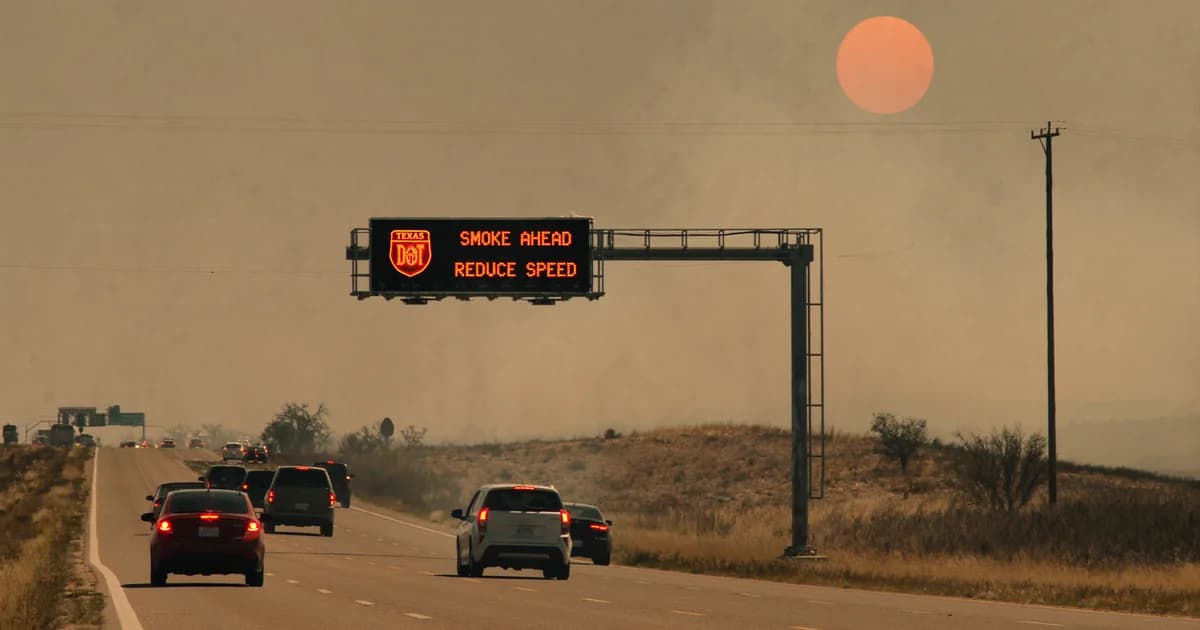
Some October mornings in El Paso, the Franklin Mountains simply are not there. Not because of a dust storm, and not because of the usual haze, but because smoke from a fire burning in the Gila or Lincoln National Forest to our north has settled into the Rio Grande valley overnight. The sun comes up orange. The air smells like a campfire. And on Interstate 10 through the middle of the city, and on the long open stretches east toward Fort Hancock and west toward Las Cruces, visibility can drop from miles to a few hundred feet in the space of a single exit.
Wildfire smoke does not behave like weather that drivers are used to. It arrives without a forecast most people checked, it is not evenly distributed, and it can be perfectly clear at one mile marker and nearly opaque at the next. That combination is what produces the worst crashes of the season: not single-car incidents, but chain reaction pileups where a dozen vehicles hit each other because none of them could see what was stopped ahead.
If you were hurt in a low visibility crash, this post explains what Texas law actually requires of drivers in those conditions, how fault gets divided when multiple vehicles are involved, and what evidence decides these cases.
Why Smoke Is More Dangerous Than It Looks
Drivers routinely underestimate smoke because it does not feel threatening the way ice or heavy rain does. The road surface is dry. The car handles normally. Nothing about the steering wheel tells you anything is wrong.
The transition is the hazard, not the smoke. A driver moving at highway speed from clear air into dense smoke loses their sight distance instantly while their speed stays the same. The distance needed to stop does not change. The distance available to see collapses.
Smoke hides the thing that matters most: stopped traffic. In a pileup, the first collision is rarely the worst one. The worst ones are the vehicles that arrive at highway speed into a scene they could not see.
Depth perception degrades before visibility does. Long before smoke becomes thick enough to obviously demand slowing down, it flattens contrast and makes it much harder to judge how fast the vehicle ahead is closing.
High beams make it worse. Drivers instinctively reach for high beams when they cannot see. Light reflects off the particulate and comes straight back, which reduces visibility further.
Texas Law Requires You to Drive for the Conditions, Not the Sign
One of the most common misunderstandings after a low visibility crash is the belief that a driver cannot be negligent if they were under the speed limit. Texas law does not work that way.
The Texas Transportation Code sets the framework in Section 545.351. A driver may not travel at a speed greater than is reasonable and prudent under the circumstances then existing. Drivers must control their speed as necessary to avoid colliding with another vehicle or person on the roadway. And drivers must reduce speed when a special hazard exists with respect to pedestrians, other traffic, weather, or highway conditions.
Read together, those provisions mean the posted limit is a ceiling for good conditions, not a guarantee. A driver doing 75 in clear conditions on Interstate 10 is fine. The same driver doing 75 into a smoke bank that cut sight distance to two hundred feet is very likely negligent even though no speeding citation was written.
Several other duties tighten in low visibility:
Following distance. Texas requires drivers to follow at a distance that is reasonable and prudent given the speed and the conditions. In smoke, a following distance that is safe on a clear day is not safe at all.
Headlights. Texas requires headlights at night and whenever visibility ahead is limited, generally when you cannot see clearly for at least 1,000 feet. Use low beams.
Stopping on the roadway. Texas restricts stopping, standing, or parking on the main lanes of a highway. Stopping in a live lane in smoke creates exactly the hazard that causes a pileup.
Chain Reaction Pileups and How Texas Divides Fault
A pileup does not have one cause. It has a sequence, and Texas law is built to handle exactly that.
Texas uses proportionate responsibility. A jury assigns each participant a percentage of the fault, including the injured person. Two consequences follow.
The 51 percent bar. You can recover as long as you are not found more than 50 percent responsible. If you are, you recover nothing. If you are found partly responsible, your recovery is reduced by your percentage. Our full explanation of how comparative fault works in Texas walks through what that means in practice.
Each defendant generally pays their own share. In most cases a defendant is responsible for their own percentage of the damages rather than the whole amount. That is why identifying every vehicle and every responsible party in a pileup matters so much. Missing one contributor can leave a real gap in what is recoverable.
Insurance companies know all of this, and in a multi-vehicle smoke crash their first move is almost always to argue that everyone shares blame roughly equally. That is a negotiating position, not a legal conclusion. The actual apportionment depends on evidence.
Proving Who Caused What When Nobody Could See
Low visibility cases are won and lost on physical evidence, because eyewitness accounts are inherently limited. The witnesses could not see either.
Event data recorders. Most modern vehicles record speed, braking, throttle position, and seat belt status in the seconds before an impact. In a pileup, downloading several vehicles establishes the sequence: who was already stopped, who braked, and who never braked at all.
Damage patterns. The geometry of the crush tells a reconstruction expert the order of impacts and the approximate closing speeds.
Roadway evidence. Skid marks, or their absence, tell you whether a driver perceived the hazard at all. Debris fields and final rest positions constrain the possible sequences.
Highway and business cameras. The Texas Department of Transportation operates traffic cameras on major corridors, and truck stops, warehouses, and businesses near a highway often have exterior cameras. Almost all of this footage is overwritten on a short cycle. A preservation request has to go out within days.
Weather and fire data. Smoke plume tracking, air quality monitoring data, and official reports from fire agencies can establish what conditions actually were at a given place and time. That matters because the defense will often claim the smoke appeared with no warning.
911 call timing. The time of the first call, and the calls that follow, help establish how long the scene existed before each later vehicle arrived.
This is not evidence a family can gather on their own in the weeks after a serious injury. It is the main reason to bring in counsel quickly.
Commercial Trucks in Low Visibility
Interstate 10 through West Texas is a freight corridor first and a passenger corridor second. When smoke settles over it, commercial vehicles change the math.
A loaded tractor trailer needs substantially more distance to stop than a passenger car at the same speed. In a pileup, that difference is often what turns a series of fender benders into a catastrophic injury crash.
Commercial carriers also operate under obligations that ordinary drivers do not have. Federal safety regulations require drivers to use extreme caution when hazardous conditions such as smoke, fog, or dust adversely affect visibility, and to reduce speed accordingly. The regulations go further and require a driver to stop operating until conditions improve when visibility becomes sufficiently dangerous. A carrier that pressured a driver to keep running a schedule through a known smoke event has a problem beyond the driver's own conduct.
Commercial cases also come with evidence that passenger cases do not: electronic logging device records, engine control module data, dispatch messages, and in many trucks, forward-facing video. All of it is subject to retention limits. Our truck accident practice sends preservation letters immediately for exactly this reason.
What to Do After a Low Visibility Crash
Your safety comes first, and in smoke that means something specific.
- Do not stand on the roadway. In a pileup, additional vehicles are still arriving. If you can move away from the travel lanes behind a barrier, do it.
- Get off the road entirely if you can. If your vehicle is drivable, an exit is far safer than a shoulder.
- Call 911 and report visibility. Telling the dispatcher that visibility is near zero changes how the response is staged and it creates a contemporaneous record of the conditions.
- Photograph the conditions, not just the damage. A photo showing how far you could actually see is one of the most useful pieces of evidence in the entire case, and it exists only if someone takes it that day.
- Note the time and mile marker. In a pileup that stretches across a mile of highway, your exact position determines which sequence of impacts you were part of.
- Collect information from more than one vehicle. In a multi-vehicle crash, the driver who hit you may not be the driver who caused it.
- Get medical care the same day. Then follow up. A continuous treatment record is what ties an injury to a crash.
- Do not give a recorded statement to another driver's insurer before you have spoken with an attorney. In low visibility crashes, adjusters ask carefully framed questions designed to get you to say you were driving too fast to stop.
Low visibility crashes and sun glare crashes share a lot of the same legal terrain. If you want the companion piece on the other El Paso visibility hazard, see our post on sun glare crashes on Interstate 10.
Talk to Lovett & Murray About a Low Visibility Crash
Smoke crashes are complicated in ways that make insurers optimistic. Multiple vehicles, shared blame, conditions everyone can point at instead of a person. That does not mean the case is a coin flip. It means the case has to be built.
Lovett & Murray has represented injured people in El Paso and across West Texas for more than 30 years. We know how to move fast on video preservation, how to work with reconstruction experts, and how to push back when an insurer tries to spread the blame evenly across everyone involved.
Consultations are free. We work on a contingency fee, so you owe us nothing unless we win your case. Our team is bilingual in English and Spanish.
Contact us today or call 915-757-9999. The evidence in a pileup disappears quickly, so the sooner we start, the more of it we can protect.
See our articles more often on Google.